
- Food travel is the fastest-growing kind of tourism. 93% of travellers want a food experience.
- The point of a food stop isn’t just the eating. It’s the people, and the story behind the dish.
- With olive oil, greener is fresher, and the more it catches at the back of your throat the better.
In the winter of 2018 I took Israel’s only culinary tourism course for licensed guides, an official Ministry of Tourism certification.
Before any of the eating, there was a day in a classroom.
That sounded like something I had to sit through to get to the food, but it turned out to be really interesting and it definitely impacted how I think about a food stop.
Our lead instructor, Hagit Avron, a guide and writer who specialises in culinary tourism, opened with a line I have since repeated many times to guests: behind the food, there are always people.
Food, she said, is in the end just an excuse; a good excuse to get to know a culture, the raw materials of a place, the landscape, and most of all the people who grow it and cook it.
“You’re storytellers,” she told the room of guides, “and food is a wonderful chance to tell a new story about a place.”
That reframed the whole thing for me. The job is not to point at a plate and announce that it’s delicious. It’s to find the place that has a story, and let the food carry it. Obviously you want to eat something good, but eating something good on its own isn’t enough; my job is to make it something more.
A bit on the numbers
We then explored a little bit about culinary tourism as a trend. It was the fastest-growing category in travel, and the figures were genuinely surprising.
Something like 93% of travellers now wanted a food-related experience on a trip, and roughly a quarter of the average trip budget goes on eating and drinking.
A food tourist spends about 45% more than a regular one. This comes firstly by buying more (including edible souvenirs to take home), but also from buying better quality at a higher price point.
The American trade body even dropped the word “culinary” in favour of “food” travel, having found that most people aren’t chasing white-tablecloth dining at all. They want the market, the farm, the person behind the counter.
What makes it more than lunch
A good chunk of the day went on the shapes a food tour can take, because they’re not all the same.
At one end of the scale, a food stop is a side dish to a normal touring day. At the other end are whole themed days built around wine, beer, a distillery, foraging, or a hands-on cooking class.
Some of the best are really urban-history tours wearing a food hat (the gentrifying Talpiot market in Haifa, where the value is the story of the neighbourhood, not just the hummus).
Hagit’s point, again and again, was that the guide has to add something beyond the tasting.
Her favourite example was about a tour of the cholent stalls in ultra-Orthodox Bnei Brak. For the uninitiated, cholent is a slow-cooked stew eaten by Jews on Shabbat, a way around the rule that you cannot cook on the sabbath; you start it before Shabbat begins and leave it on a low heat.
This was of particular interest to me as the former Ladlemaster of the little-known but passionately attended Cambridge University Cholent Society(!).
Hagit let us in on a secret: “Nobody comes to Bnei Brak to actually eat the cholent.” It is cooked in vast batches and it is not really that tasty. People come for the world it opens a door onto: the world of ultra-Orthodox Judaism, which most visitors never step inside.
We also got into the vocabulary a guide is expected to know.
For example, we discussed the concept of terroir, the idea that a place and its people produce a specific flavour, now applied to food as much as wine (goat cheese from the Judean hills tastes different to the same cheese from the desert).
We then explored agritourism, an Italian invention for keeping small farms alive. And then talked farm-to-table and “zero kilometre”, which sound very modern until you remember, as Hagit put it, that the Arab villages and Bedouin of the Galilee have lived exactly that way forever, and find the Tel Aviv excitement about it quite amusing.
Then, the olive oil
The hands-on part of the day was an olive oil tasting, led by Benny Ben Israel, who knows the rural food world here as well as anyone and later became a contestant on the Israeli version of MasterChef.
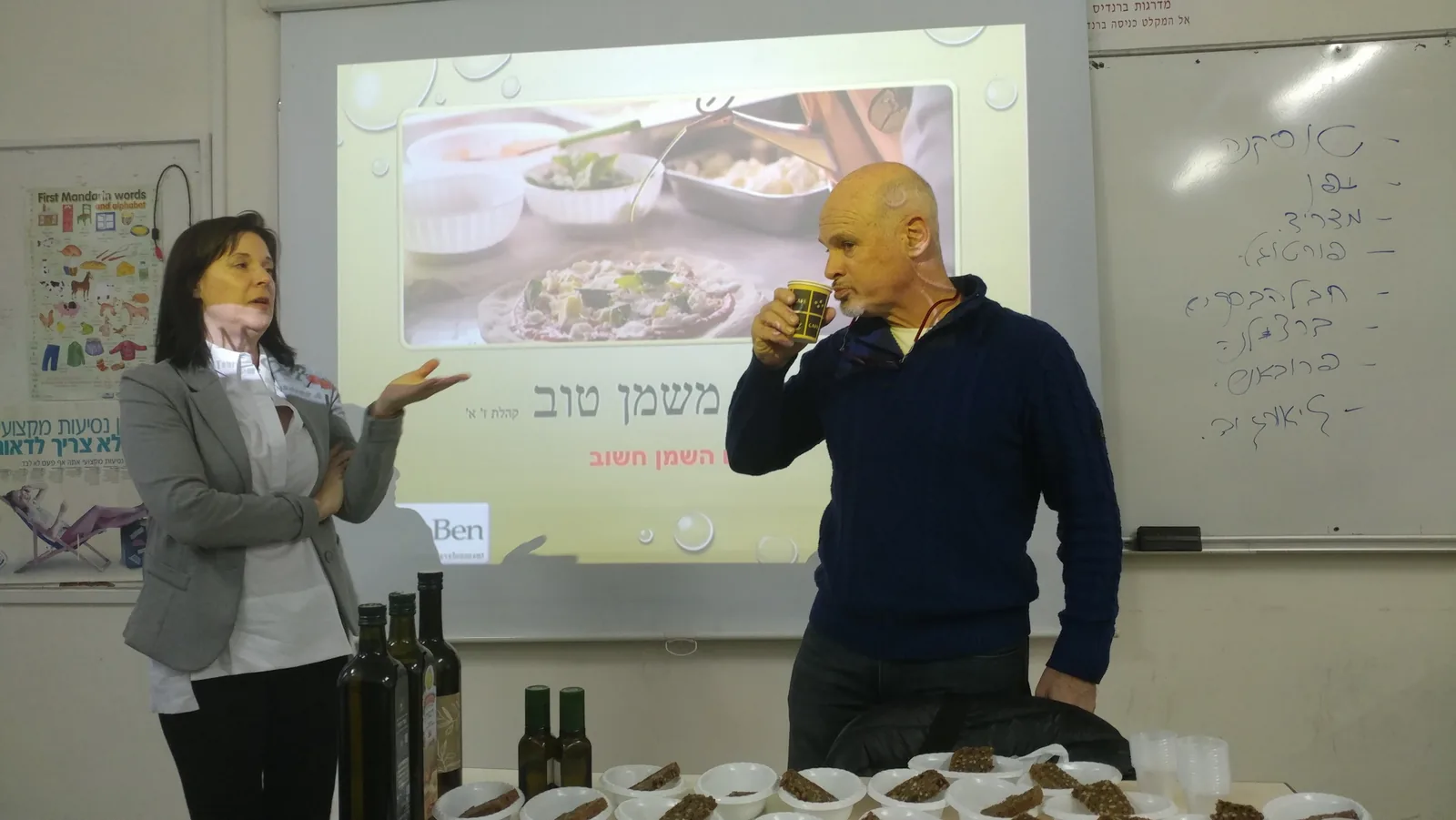
How do you tell a good oil from a tired one? Colour first; the greener, the fresher.
How do you taste it? Take a little in your mouth and breathe in over it. The more it catches and burns at the back of your throat, the better and younger it is.
Oxygen is the enemy, so keep your olive oil in glass or a tin and never plastic, and use it within a month or so of opening.
By the end of the day we had the theory, the numbers and the language. The rest of the course was out in the field, tasting our way around the country.
First stop, the following week, was the Sharon.


bottles of olive oil need to be stored in a cool dark place. Plastic bottles (for example from supermarkets) are fine if stored like that.
Thanks! I’m only reporting what they told us in the course. You rarely see olive oil in plastic bottles over here.