
- How to read a market: prices normally start high at the entrance and fall as you go in.
- No matter your ailment, there’s a market ‘pharmacist’ to fix it with a custom juice or spice blend.
- Everyone we met was full of passion and dedicated to perfecting their craft.
In the winter of 2018 I took Israel’s only culinary tourism course for licensed guides, an official Ministry of Tourism certification. This was the fourth and final field day, and after the farms, the wineries and the long haul up to the Galilee it was definitely the most chaotic. A morning in the Carmel Market in Tel Aviv.
Our guide was Nurit Goren, who describes herself as living, breathing and dealing in food 24/7. She spent years running some of the most respected restaurants in the city and working with the big chefs. When a foreign television channel turns up to make a programme about the markets of the world, she’s the one they call, and she’s been dubbed into a long list of languages.
Nurit has lived in Kerem HaTeimanim (The Yemenite Quarter), the neighbourhood behind the market, for ten years, and she has been walking people through the market almost every morning for five and a half.
She knows many of the stallholders very well and because her daughter’s nursery is in the middle of the market, so she gets live reports on the child all day from people behind the stalls.
I also have an indirect connection to the market. My wife’s maternal grandfather had a stall there, selling clothing, which is now run by her uncle. And on her Dad’s side, he has two cousins who run a well known nuts stand. And I often swing by to do my shopping.
Still, it turned out I had a lot to learn!
How to read a market
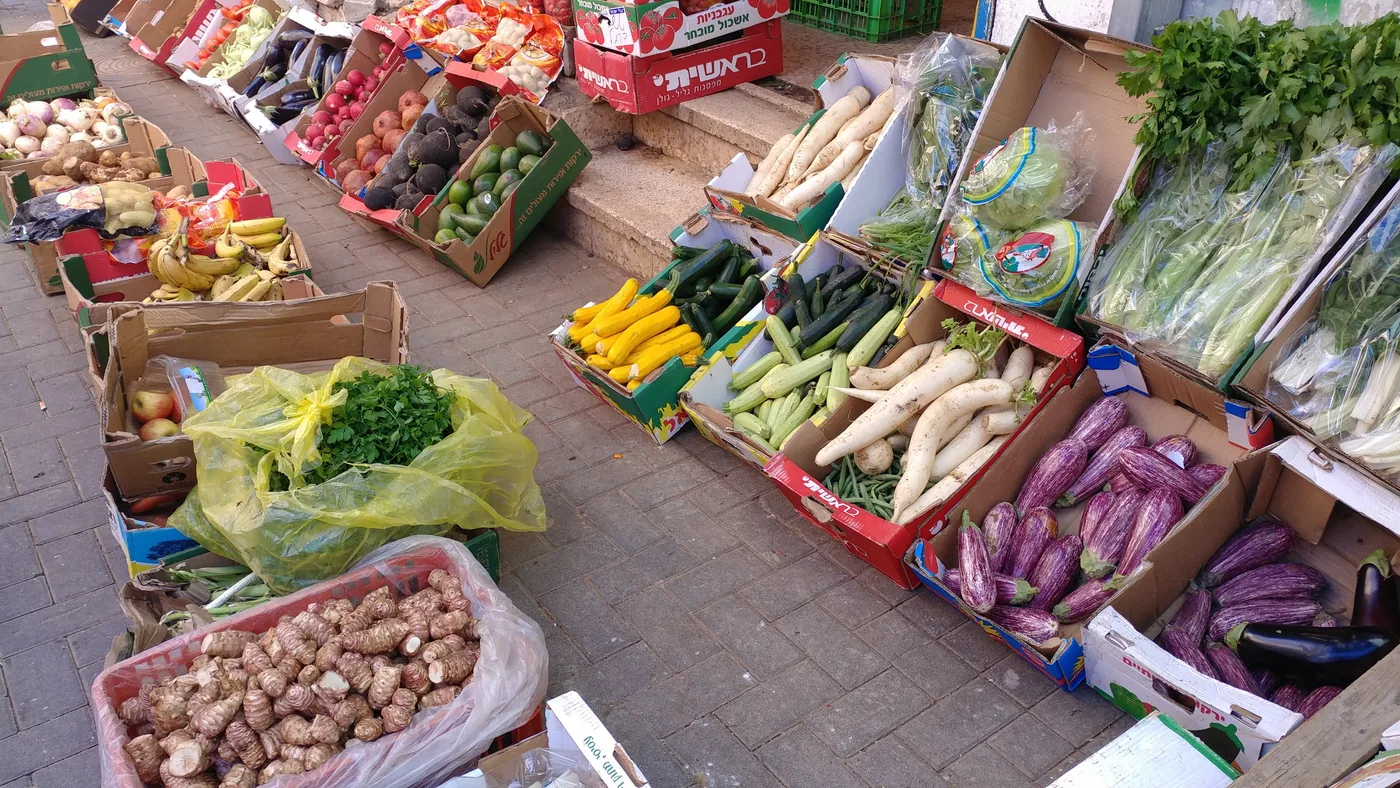
The first thing Nurit taught us is a rule that she says holds in nearly every market in the world. It always starts expensive and gets cheaper as you go in.
She continued: in the Carmel, at one end there were sometimes no prices displayed at all, and no visible weights. You need to be wary.
She also advised to read prices carefully. Somebody will tell her they saw peppers cheaper at the top of the market, and she will point out the tiny writing underneath saying that four shekels was per half kilo (the normal measurement is per kilo).
Three of her favourite people
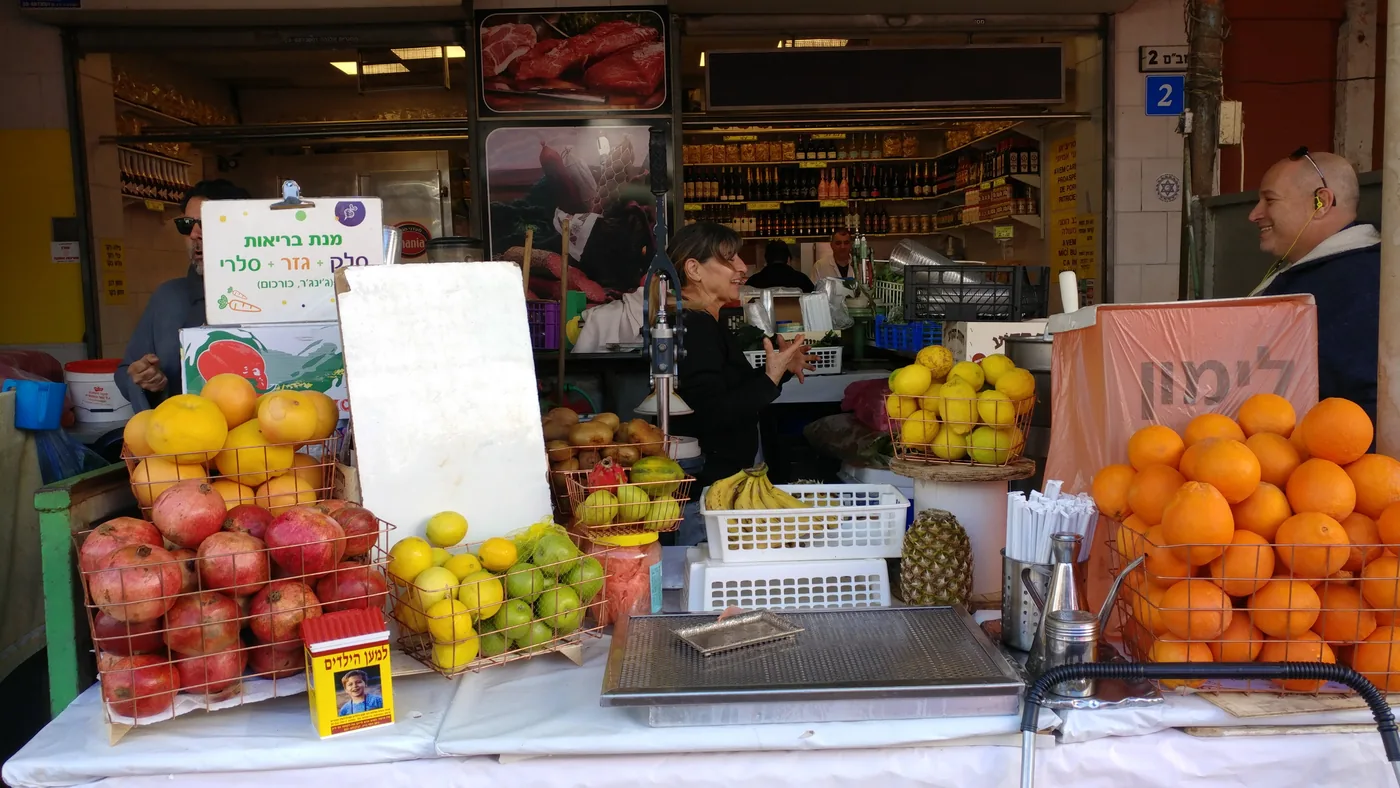
Nurit started our tour by visiting three of her favourite people in the Carmel Market.
The first stop was Beer Bazaar, a small beer stall about to turn five years old. It was started by three young men, one a fighter pilot and one an engineer, with the idea of selling only Israeli boutique beers, a hundred kinds of them, from the northernmost brewery in the country to the southernmost. Five years on they had seven branches, one of them in Berlin.
It was a bit early in the day for beer but the group valiantly did their best to make the most of the tasting, some more eagerly than others.
The second stop was Elad’s falafel, which she rates as the only falafel in the country she’s willing to eat. She used to say she was a fake Israeli because she can’t stand the stuff, in her own words: “greasy squashed balls shoved in a pita when the country has so much better food than that”. Honestly, I beg to differ; I’m a big falafel fan!
What changed Nurit’s mind was a trip to Jordan, where she woke up one morning with an inexplicable craving for falafel, went hunting for the best one in the area, bought a bag of it and admitted to her husband it was delicious. When she confessed this to Elad, he said that it was unacceptable that she would eat falafel in Jordan and not try his; he would be sending some over.
The stall was opened by Elad’s father, but only his mother knows the recipe. She makes the mixture at home and sends it over for Elad to fry up and serve up in a pita.
The third stop was Tikva, who Nurit calls the doctor of the market, because whatever you need, she has a juice for that. Tikva looks at you and decides what you need: a juice for your skin, for a diet, for cleansing, for blood pressure. She reckons she can spot a pregnancy before you say anything.
The ingredients for her juices are often a bit unexpected, including celery, parsley, coriander, broccoli, cucumber and sweet potato. Then she adds olive oil and black pepper to everything. The juices are dense in vitamins and minerals, and without a few drops of fat from the oil, most of it goes straight through you. The black pepper helps make the turmeric more effective. The queue for her stall can run to forty minutes.
The synagogue that never was
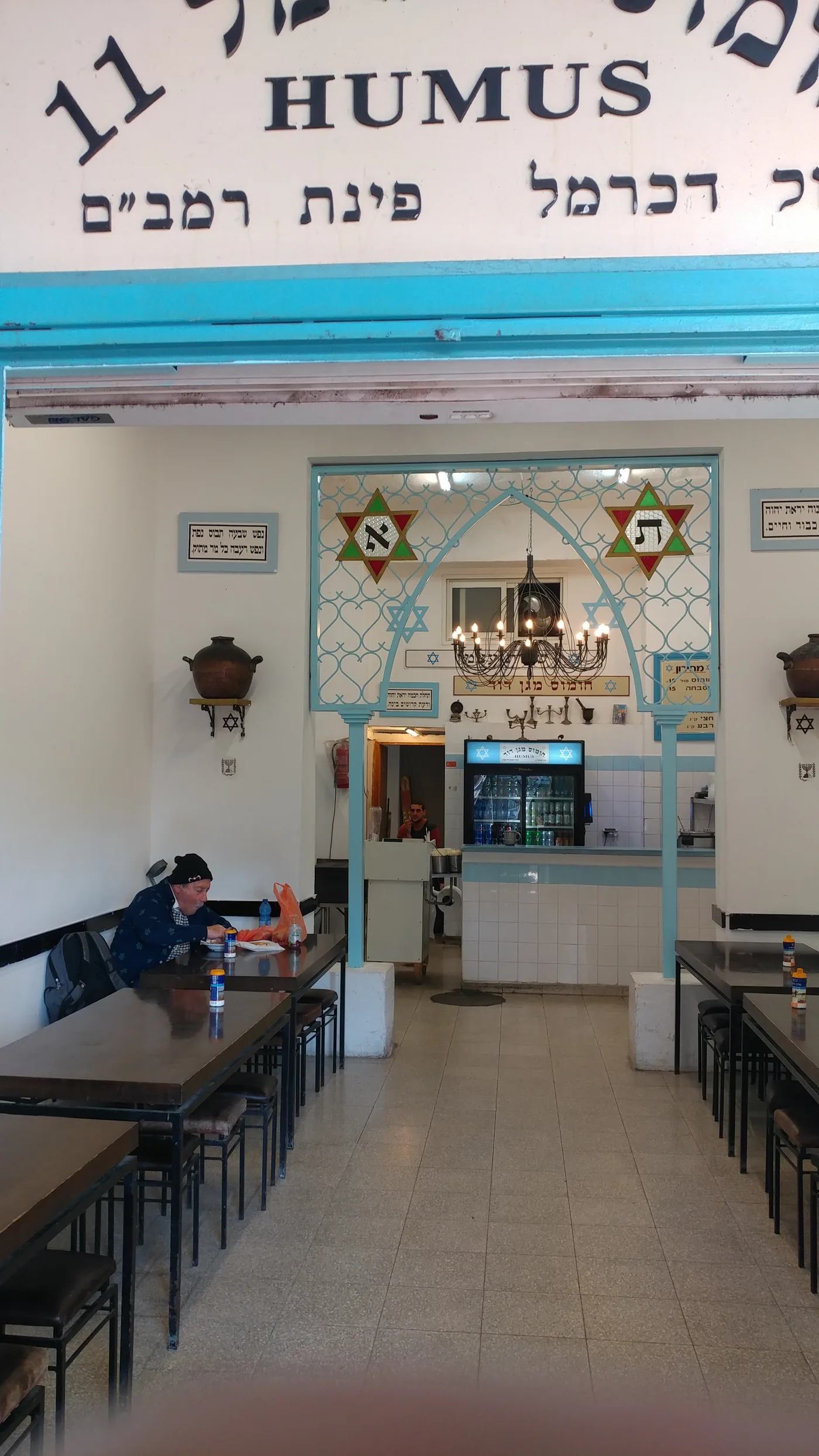
Nurit sent us round the corner to look at something without telling us what it was. It was a hummus place with a Star of David on the outside.
Inside were stained glass windows, a chandelier, a decorated ceiling, benches, shelves of holy books, verses on the walls and an ark. Every single sign that the room was once a synagogue.
Tourists adore it. Hummus in a synagogue. The owner tells everyone that it was one, and that until a few years ago the stallholders used to come in and pray. These days they pray less but they still take a lunch break, and what they eat is hummus, because it’s cheap and filling and good and you eat it in company. So, the story goes, the place made the brilliant leap from synagogue to hummusiya so the same men would keep coming through the door.
It’s a lovely story. But the building was never a synagogue. It was a sausage factory, and not in the distant past either.
Nurit said the owner is a genius, a great interior designer and a first-rate marketing man. She also noted that hardly any of the visitors notice the room faces away from Jerusalem (synagogues are supposed to face towards it).
The hummus was good though!
The place was called Hummus Magen David. Sadly, it has since closed its doors.
Herring, and a horse’s saddle
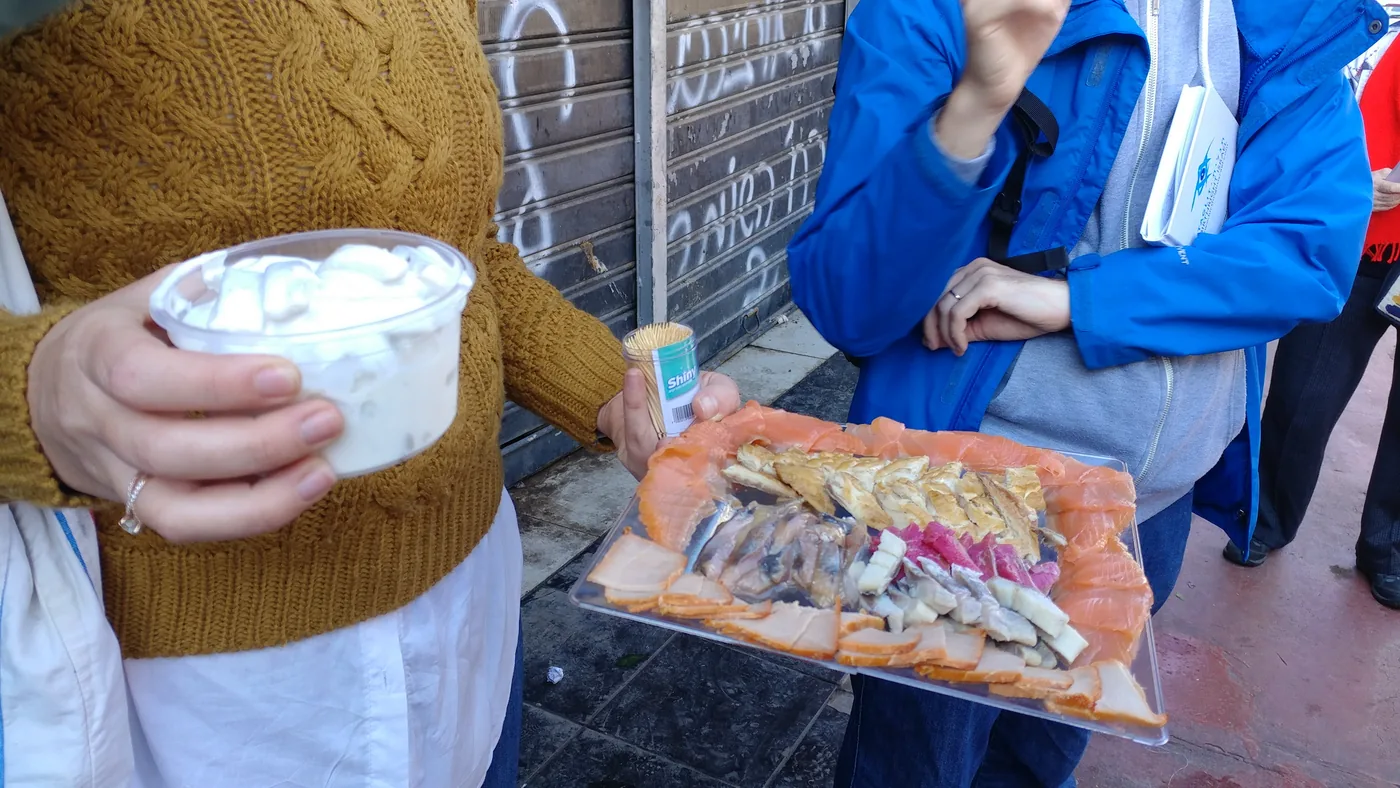
A lot of the food that you eat in Israel has origins from somewhere else. Immigrants brought it here and along the way it became Israeli. At our next stop, Nurit took pickled fish as an example.
She traced curing back to horsemen crossing Europe with meat and fish for the journey, who tucked the food under the saddle to keep the sun off it. When they stopped they found it had gone very salty and very good. The horse’s sweat had cured it.
From there she got to the three things that will keep food more or less forever. Salt is the first. Sugar is the second, which is why jam, honey and dried fruit last. Third is vinegar and lemon although she clarified that they pickle, they don’t preserve.
The stall itself belongs to two brothers, the third generation of their family to salt and smoke fish. They are proud that the permit to open it came from Herbert Samuel, the High Commissioner under the British Mandate.
There are photographs on the wall of former prime ministers including Rabin, Begin, Shamir and Peres, and their fish would often be taken straight to cabinet meetings. Nurit said one well-known politician still shops there.
We also learned where the word matjes (in English “Maiden” or “Soussed” herring) comes from. Matjes is a very popular type of cured herring in Israel (my father-in-law and wife both love it).
In Holland the first herring catch of the season is a national event, near enough a public holiday, with families going down to the ports for it. Those first fish are so young that they haven’t developed a reproductive system, which makes them, technically, virgins. Virgin in Dutch is matjes. The first delivery traditionally goes to the king.
Matjes is therefore always young herring, pinker in the flesh, and as the fish ages it pales into the whiter herring most of us know. Nurit reckons there are perhaps ten places in the country selling the real thing.
She also ruined supermarket salmon for me. Salmon is born white, and turns pink from the algae it eats swimming against the current. Farmed salmon are white fish fed colouring pellets, with less fat because the pool is never as cold as the sea. Her rule of thumb: under a hundred shekels, it came out of a pool.
Coffee is born green
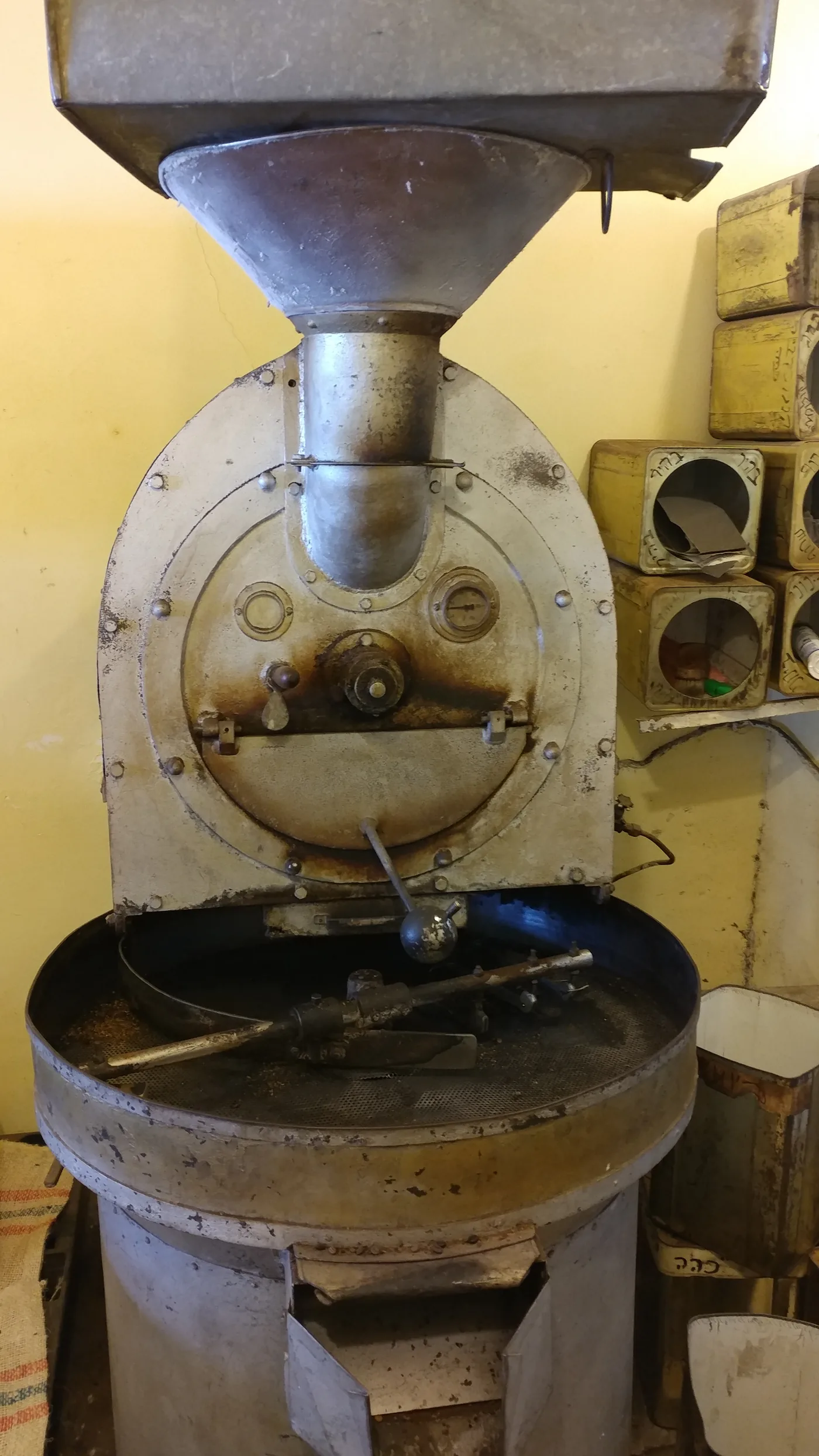
Round the corner we met Shlomo Cohen, who is the third generation of his family to roast coffee and was born in the building. His daughter lives upstairs. People come to him to buy coffee beans.
He still roasts over a flame on a machine that’s nearly seventy years old, in very small batches.
He explained that coffee beans are originally green, have no coffee smell, no coffee taste and nothing about them that suggests coffee at all. Everything we recognise is created in the roasting.
Nurit threw in the origin of the americano while we drank. American soldiers in Italy during the war, exhausted and used to weak coffee at home, were handed espresso and found it undrinkable, so they asked for hot water in it. She did a good impression of the Italian barista’s facial expression!
The king of soups
Round from the coffee we passed Shimon, whose restaurant, Melech HaMerakim (The King of Soups), is an institution in its own right. Using traditional Yemenite techniques, he’ll make you a soup out of just about any part of the animal: the head, leg, even udder.
The standing joke is that the only bits of the cow he can’t use are the bell round its neck and the rope you lead it with. His daughters run the restaurant now.
The spice she handed out at her own wedding
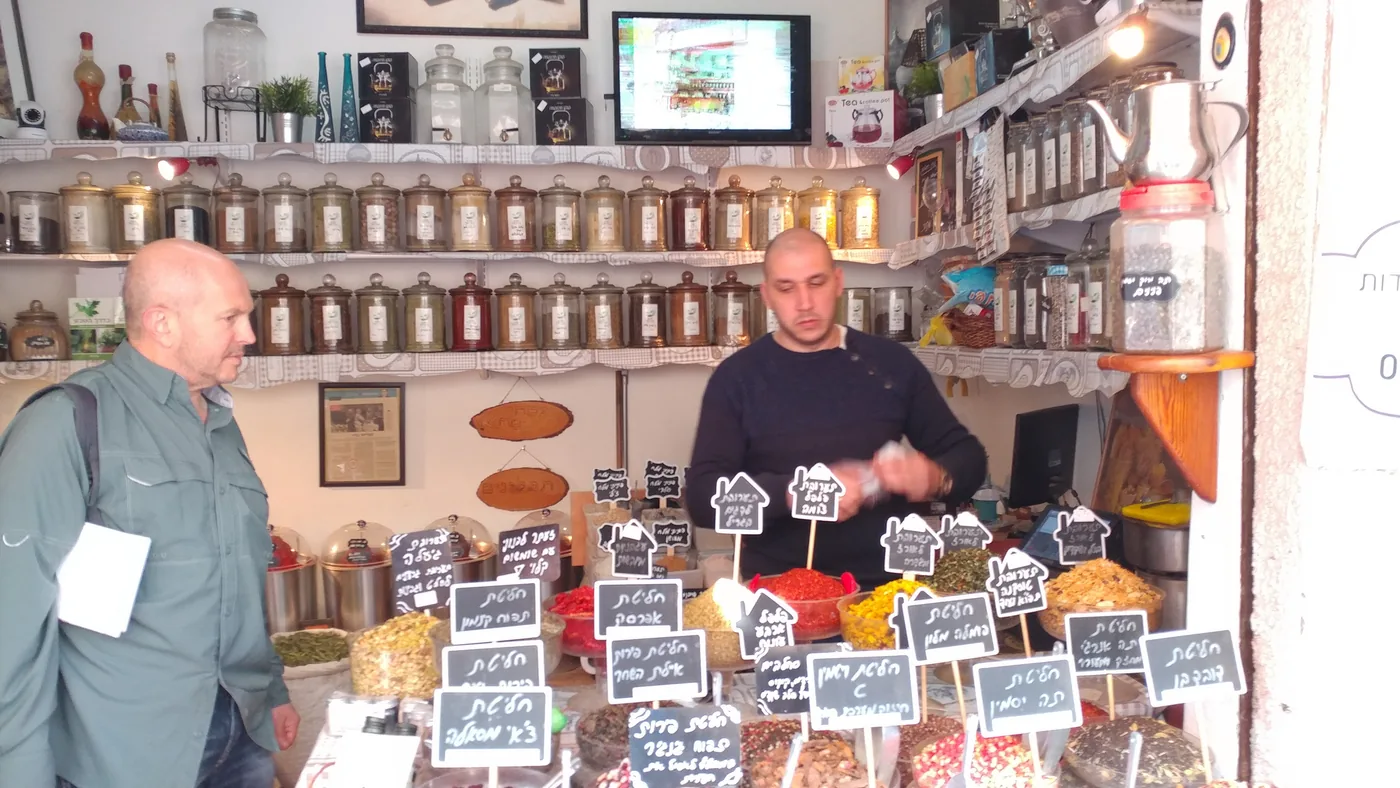
The spice stalls are always a highlight in the market. We stopped at one that Nurit calls “the pharmacy”. Roni, who runs it, is used to people turning up with some ailment, and he’ll make up a blend to suit each one, the way a chemist fills a prescription.
Among his stock are something like ten different salts, including a black one from Hawaii that takes its colour from the island’s volcanic soil, and a celery salt he makes himself by drying the leaves.
Nurit was effusive about the ras el hanout (literally: head of the shop) spice, a blend which every spice store puts its own spin on. She calls it the doctor of food: put it on almost anything and it makes it better.
Her argument for blends over single spices was solid. You can add a bit of this and a bit of that yourself, but a good blend is always better, and it’s like a family or a marriage: the same ingredients every time, and it comes out different in every house.
She liked it enough that when she got married, instead of the usual fridge magnets, the guests went home with little jars of ras el hanout. She turned up with jars for all of us too, along with the smoked paprika we had been tasting.
Coming to a close
And that was the end of the course. Five days: one in a classroom and four on the road, from the farms of the Sharon to a market I had walked through a hundred times without seeing any of this.
We finished it a lot more knowledgeable, quite a bit heavier, and excited to implement all that we’d learned into our tours.
If a morning like this sounds like your kind of thing, it’s exactly the sort of thing I can build into a trip. You can see where it fits in my Israel: a culinary melting pot itinerary.


Leave a comment