Archaeology of the Biblical Negev

After various introductory field trips we are now at a stage where our weekly excursions are broadly supposed to tie in with what we are studying class. Therefore, as we began our lessons on archaeology we spent last week exploring some of the tels (archeological mounds) in the north, and this week we were doing the same but in the south, in the biblical Negev.

However, our first stop was unconnected. En route on the border of the Judean lowlands and the Negev is the Joe Alon Centre for Regional Studies (focused on the Negev region).

Learning about Bedouin culture at the Joe Alon Centre

The main part of the centre (and, in my opinion, the most interesting) is the museum about Bedouin culture. The Bedouin are a nomadic people who in Israel are mostly located in the Galil and desert regions. They are moving away from their traditional life and now the majority live in fixed accommodation; however on travels through the desert it is still possible to see their tents. Although the displays are a little tired and don’t look like they have been touched since the museum opened in the 80s, there is still a lot of interesting information and we were accompanied by a Bedouin guide who went into more details. There was also a short film about the Bedouin in the Negev which was a very good and concise introduction to their lifestyle and the challenges they face in the modern world.

After being led around the museum we were taken into a traditional tent structure where we were served sweet tea and learned about the important culture of hospitality. A most pleasant experience.

From there we quickly looked at the replicas of various cave dwellings in the Negev, from the late stone age to the Bar Kochba revolt, and enjoyed the view over the area from the elevated viewpoint. The tours and videos are available in English (although you probably need to call ahead) and it is a nice stop if one is heading southwards.

Descending into the vast water system at Tel Beer Sheva

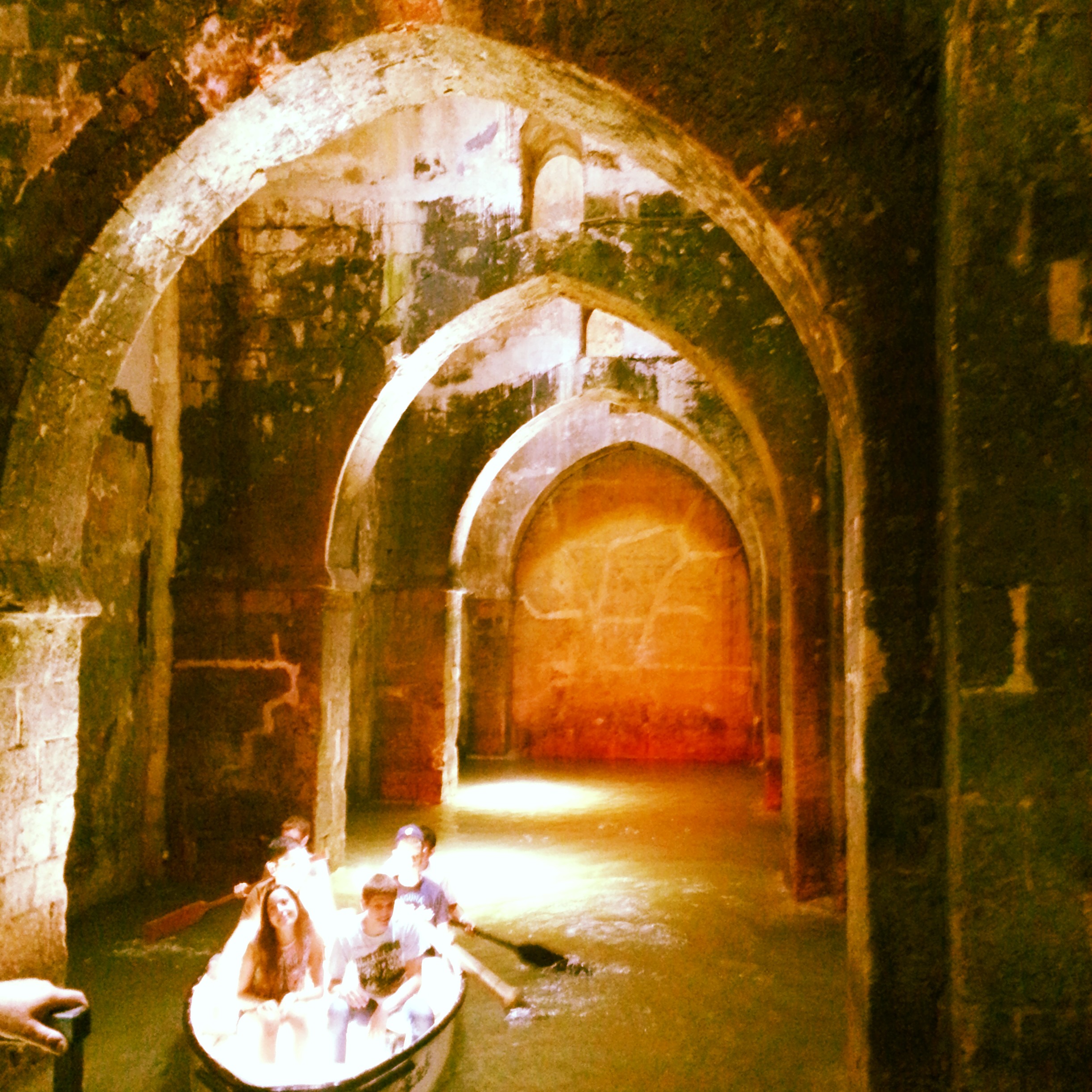
We continued south to the region of the biblical Negev. Unlike the Negev of today, this was located only in the area of the valleys of Arad and Beer Sheva, and was a border region between the desert and the rest of the country. Our first destination here was the UNESCO world heritage site of Tel Beer Sheva. Located near modern Beer Sheva, it is considered by some to be the site of the biblical city where Abraham dug his well. The remains on the mound are later, from the post-Exodus period of the Israelite kingdom. They are very impressive (hence the UNESCO recognition). Our guide took us around, explaining the function of different structures and our theories on their uses and purpose. Most incredible was the underground water system, constructed in case of a siege. Huge caverns had been hewn out of the rock and covered with plaster; water was then secretly diverted from the nearby Hebron stream (when it was flowing) into this underground reservoir. We walked out through this water system (for extra fun, we were required to wear hard hats!) and saw the replica of the altar they found at the site; an impressive cube structure with horns on each corner; the original is now in the Israel museum.

Remains of a late Canaanite period 'Arad House' at Tel Arad
Remains of a late Canaanite period ‘Arad House’ at Tel Arad

Our final destination was at Tel Arad, located just outside the city of the same name, where we were honoured to be guided by one of the site’s main excavators. This tel is important as it contains the remains of a vast city from the early Canaanite period, with no further layers above it. This means that archaeologists can use it to really understand what life was like in this period, without the confusion of having other later constructions intermixed. We learned about the typical building construction, now found in other places but still called the ‘Arad House’ as it was here that it was discovered for the first time, and in such large quantities. Our guide also explained to us his theory that the Israelites came into Israel about 1000 years earlier than the current received opinion. Sadly (for him) he seems to be rather alone in this point of view, although he argued his case well. Given that it would mean reorganising the entire chronology of the ancient world, I can see why there might be some resistance.

The original altar in the temple at the Israelite fortress in Tel Arad

We then went up the hill to visit the Israelite period fortress. Although there was no inhabited settlement here since the early Canaanite period, there were fortresses along the border with the unruly desert nomads. The fortress was a large impressive structure, and contains the remains of a temple; evidence that there were other temples outside of the main one in Jerusalem. It seems to have been destroyed at some point, perhaps as part of the concentration of ritual Judaism into the capital city.

We enjoyed the stunning desert sunset over the ancient ruins and then began the long journey home.

Sunset over the ruins of the Israelite fortress at Tel Arad

The Ancient Sea Road (Via Maris)

It is the day before our weekly field trip and Israel is in the midst of its worst storms for ten years. The main motorway in Tel Aviv is flooded and closed. The trains aren’t running. Snow is forecast in the Golan and in Jerusalem. Amongst these fierce winds and torrential rain, some of the course members contact our coordinator. Surely tomorrow’s field trip is cancelled? It seems that it is not. Disbelief. And the beginnings of a mutiny. But in our night class, our coordinator makes it clear: “the tour guide course goes out into the field, even through fire and through water” (I think it sounds better in Hebrew). He was almost seeming to relish it. The rebellion was quashed.

So it was that we assembled, as usual, at 6.30am at Arlozorov bus station. Except this time we were all looking somewhat larger due to the multiple layers of clothing and waterproofs. Spirits were surprisingly high. We were in this together, “through fire and through water”. And off we set.

Our trip was to be connected to the Via Maris, the ancient Sea Road connecting the two great regional empires of Egypt and Mesopotamia. In the end, only some of the sites were connected to this road, but the majority of the day dealt with those that were. Remarkably, as we headed north the skies began to clear. A miracle?

El Ahwat
El Ahwat

Nonetheless, the ground was extremely muddy at our first stop at El Ahwat. An archeological site dating from the Bronze age, some believe that this is the home town of the biblical character Sisera who famously met his end when Yael bashed a tent peg into his head. There seems to be a connection in the architecture with the Nuragic culture of Sardinia, and a theory is that the people who lived here came across the sea bringing their culture with them. Unfortunately the site was rather inaccessible as it was effectively a very large bog. But we got a bit of an idea. Sadly the bus driver was not so appreciative of the mud adorning our boots.

Katzir Viewpoint
Katzir Viewpoint

We carried on a short drive to the small town of Katzir where we enjoyed a viewpoint over to the Carmel. Our guide pointed out key sites including the route of the Via Maris and the topographical features of the area. With this overview we moved on to the site that was to form the largest part of the day’s itinerary, Tel Megiddo.

A Tel is an archaeological mound. At some point in ancient history a group decided that point x was a good point to settle. Perhaps it was close to water, had good fields for agriculture, was easy to defend etc. Over the years the settlement might be destroyed, or deserted, and then later rebuilt, each time over the previous ruins, rising up and up to form a Tel. Israel is full of these Tels, each of which is an archaeological treasure trove of different periods of history. And one of the richest is Tel Meggido.

Model of the Israelite city at Tel Meggido

The site was made a UNESCO world heritage site in 2005 and has been under excavation since the beginning of the 19th century. And they’re still finding more and more. It had a prime location at a key junction on the Via Maris, close to arable land and a constant water supply, leading to many battles for its control. Eventually the Israelites wrestled control of it from the resident Canaanites and most of what is visible in the excavations is a mixture of the Canaanite and Israelite periods. Most impressive are the series of Canaanite temples on the east side of the Tel (facing the sun).

Sadly our excursion on the Tel was somewhat hampered by the darkening skies followed by hail. Yes, hail. Despite this, we gallantly continued around the site through bouts of being pelted by ice pellets. And our brave guide managed to impart to us a great deal of useful information. I think though, it will be worth a return visit in better weather.

View from the east side of Tel Meggido

Also of note is that Tel Meggido has been identified with the end of days vision of John at Armageddon. Har is Hebrew for mountain/hill; Har + Megiddo and the connection makes sense. Furthermore, a few hundred metres away has been unearthed a mosaic floor containing an inscription with the earliest known reference to the Christian religion. Hence there were a few groups of Christian tourists also braving the weather with us, and they have my full respect for doing so!

View from Tel Jezreel

From Meggido we moved on to Tel Jezreel, another archaeological mound along the Via Maris. Our guide took us through the generations of occupancy of the mound from the Israelite period through to the Romans, Crusaders (the ruins of a church have been uncovered here) and the Arab village that was here for 100 years prior to 1948. We learned about the battle that took place here between the Israelites and the Philistines as recounted in the Book of Samuel, and then the later battles that took place here in the Israeli War of Independence. On the way out of the Tel we passed the monument for the soldiers who died in the battles to control the mound in the modern era.

Ancient Beit Alfa Synagogue

It was time to leave the Via Maris and our next port of call was at the ancient synagogue at Beit Alfa (somewhat confusingly located not in Kibbutz Beit Alfa, but in Kibbutz Heftziba, next door). The ruins of this ancient synagogue from the time of the Second Temple have been loving restored including a stunningly impressive floor mosaic. Interestingly, the mosaic includes the signs of the zodiac and an image of a foreign god. I doubt they would be allowed in synagogues today but it seems that in these ancient times they were just perceived as decoration (and indeed something that the people who made the mosaics knew how to do). Inside the synagogue you can watch a rather cute film which acts out the hypothetical story of the mosaic’s creation. It is a cute and creative way to explain what is before you and makes the site much more engaging, certainly for children but for adults alike.

View from Mt Barkan on the Gilboa

We concluded the day by driving up to the Mt Gilboa ridge at the edge of the Samarian hills. As we went up the steep ascent we were treated to stunning views of the valleys below bathed in sun with the streams running full of water (many of the streams in Israel are dry most of the year) and the fields rich colours of green and brown. We arrived at our first lookout point at Mt Barkan, the highest point on the ridge, but sadly the explanation of what we were seeing was curtailed by another hailstorm, this time the hail was around half a centimetre in diameter and it really hurt! Our guide bravely struggled on but eventually had to concede that our exposed position on the mountain top was not perhaps so wise in the current conditions. Still, we briefly enjoyed the view.

View from Mt Shaul on the Gilboa

We carried on a little further along the Gilboa scenic road to Mt Shaul. The hail had turned to light rain so we alighted and enjoyed the stunning views while our guide read to us the sad story of the first Israelite king, Saul. He is said to have fallen on his sword at this point. It is also apparently a very good spot for paragliding. The clouds parted so we took advantage to walk a short trail around the peak before returning to the bus, homeward bound.

The Jordan Valley

As we move into the winter months the Jordan Valley was a welcome itinerary as it is well known for having somewhat warmer climes. We left Tel Aviv and ascended up to the Judean Hills into a dense fog, we were enveloped in an ambiance of mystique and perhaps slight foreboding as we crossed over the Green Line and headed to the town of Maale Adumim, and the Martyrius Monastery.

Dining room at Martyrius Monastery

The Monastery dates from the 5th Century (the Byzantine period). Today we would learn about the movement of monks in the Judean desert which is said to have begun with the arrival of Chariton in the year 337. This was an extremely significant movement numbering 20 000 monks spread across 60 monasteries by the middle of the 6th Century. The first monasteries were called laura and consisted of a central cave for the head monk with smaller caves around it. They then evolved (often on the same site) into built structures for communal living known as a coenobium.

This monastery, named for the monk who was at one time Patriarch of Jerusalem, was a large structure housing around 250 monks and also offering lodgings to pilgrims on the Jericho-Jerusalem trail. As we wondered around the ruins our guide explained about how the monks would live in the desert conditions.

We then drove down the hill to the St Euthymius Monastery which has been excavated in the heart of the Maale Adumim industrial zone. St Euthymius inherited Chariton’s mantle as the major monk in the area of the Judean desert having come here from Armenia. He moved around several times but died and was buried in the site upon which the monastery was built. Much of the structure is original although some was restored at the time of the crusaders. In order to prevent his bones being removed by pilgrims St Euthymius left special instructions about a final to be placed above his tomb for them to anoint themselves on. We found the funnel, but sadly his bones were removed at some point in history and are now somewhere among the relics held by churches in Europe.

Inside a vast cistern at St Euthymius Monastery

Particularly impressive was the vast cistern (one of two of this size) used to capture as much rain water as possible to survive the desert heat. We climbed down to the bottom and gazed up at this incredible structure hewn into the chalk rock. An extremely impressive feat of engineering, it even used techniques to protect it from earthquakes (which evidently worked).

To add to the ambiance, our guide played the song “El Borot Hamayim” (to the water cisterns) and handed out sheets with the lyrics. A nice sing along was had.

Inside the church at the Monastery of St Gerassimos

We moved on past Jericho and headed North up route 90 to our final monastery of the day, that of St. Gerassimos. He, like Martyrius, was a disciple of St Euthymius and was credited with pioneering the establishment of monasteries in the area of Jericho. The site was restored over the past 30 years by the Greek Orthodox church and there are now lodgings there for pilgrims together with small mosaic and candle making factories. The church has been refurbished and there are beautiful paintings of various saints and scenes from the bible, together with a brand new home made mosaic floor. The surroundings are very peaceful and shady in the desert sun although sadly they offer no respite from the desert flies.

From this monastery it was a short trip to Qasr el Yahud, an old deserted crusader period monastery on the site of a church dedicated to John the Baptist and built on the orders of Helena (mother of the Roman emperor Constantine, who also ordered the building of various churches in Jerusalem including the Church of the Holy Sepulchre). Just a few meters further and we found ourselves at the bank of the Jordan River at the site where John the Baptist baptized Jesus, effectively founding a new religious movement. There were many groups of pilgrims from around the world quietly praying or singing hymns together; it was a very special ambience.

A pilgrim collects water from the Jordan River at the site of Jesus's Baptism
A pilgrim collects water from the Jordan River at the site of Jesus’s Baptism

The site is also important in Jewish history. It is here that the Israelites entered the Land of Israel for the first time, and where they spent their first Pesach as a free people. It was also the site where the prophet Elijah passed on his leadership position to Elisha before being whisked away to heaven in a chariot of fire. It is a site associated with new beginnings.

Jordan Valley Monument

After a spot of lunch our trip took a more sombre turn as we visited the Jordan Valley monument. Designed by the artist Yigal Turmakin and constructed from old parts of armoured vehicles, tanks and guns, it serves as a memorial to the Israeli soldiers who died in the area, particularly as a result of the period known as the period of pursuits. Once Israel took control of the West Bank in the 1967 Six Day War, Palestinians began to infiltrate from Jordan and carry out attacks. Many soldiers lost their lives to this guerrilla warfare and they are commemorated here.

The site also commands an impressive view over the Jordan valley and into Jordan itself. Our guide pointed out the sites of former strongholds of the Jewish Hasmonean kings in the area together with modern agricultural settlements.

View over the Jordan Valley at the Jordan Valley Monument

From the monument we took the winding road known as the Alon Road (after Yigal Alon, a former army commander and politician) deep into the Samarian hills. The scenery was stunning although it was also a little eerie; much of the area was deserted. Occasionally we would pass small villages or other signs of human life such as olive tree groves and a herd of goats with their shepherd. As we went through our guide pointed out sites mentioned in the bible or of significant excavations. There is a great deal of history in these hills.

Eventually we reached our destination at the Mabua spring in Nachal Perat. The spring is unusual as due to its unpredictable flow. There is an underground cave which fills with rainwater seeping down through the rock. When the water reaches a certain level in the cave, due to a sort of U-bend eroded in the work, the water bursts out into the spring.

Remnants of Hasmonean Aqueducts at Ein Mabua

As dusk fell we walked into the Nachal noting the remnants of what used to be a vast system of aqueducts across the desert, carrying water from the various springs to the Hasmonean fortresses. Now they are in ruins and merely serve as a playground for rock squirrels. We concluded with a little more of group sing song by the spring and with the sound of music in our ears it was time to return home.

The Lower Galil

The green and hilly region of the Galil in the North of Israel is divided into two, largely based on topography. The Lower Galil is lower in two senses of the word; it is both further to the South and has lower hills (affectionately referred to as mountains in Hebrew).

The Galil is a beautiful place to visit. The rolling green hills make a beautiful backdrop; they are filled with hiking trails. It is also an area of great historical significance. The Galil contains the city of Nazareth, the childhood home of Jesus, and a lot of the miracles he performed took place here. From a Jewish perspective, it became one of the main Jewish centres after the second temple was destroyed; there were several towns here which hosted the Sanhedrin, the Jewish parliament, and indeed the Mishna (Oral Law) was codified in one of these towns, Tzippori.

But neither Tzippori nor Nazareth were the focus of today’s trip. Rather, we were to get an overview of the region. This overview began at Tel Chanaton. A tel is an archaeological mound. This means that it was a dwelling place for man over several centuries, and was destroyed and rebuilt several times. Each time it was rebuilt, the new settlement was constructed on top of the remains of the old one, and the mound grew.

Tel Chanaton was a dwelling place of man from the Bronze age up until the end of the Persian rule in Israel, roughly a period of 3000 years, and then intermittently afterwards. It is mentioned in ancient sources including letters between Canaanite kings and indeed the bible. From our lookout on the tel we learned about the topography and geology of the Galil in addition to the importance of its situation close to several ancient trade routes. It was a place for people to stop off while travelling and restock food and water. In later times it was also used to collect taxes from travellers.

Remains of Crusader Fortress at Tel Hanaton

Israel is full of these mounds and many have been extensively excavated, but Tel Chanaton has not yet. Some excavation has taken place though and you can squeeze into a small tunnel that takes you into the remains of a Crusader fortress that was based here. There is something quite remarkable about being inside it, knowing that it was not originally buried in the earth. It helps understand the other mounds you see, knowing that all the remains were originally like this.

We moved on from the tel to the Muslim Arab village of Kaukab Abu al Hija. This village is named after the great Husam ad-Din Abu al-Hija, a lieutenant of Saladin. He was known as a righteous man, a man of the people, who encouraged good relationships between Jews and Muslims. We heard a couple of the legends of his time in charge of the area.

In more modern times, this village stood out in the area by embracing the arrival of new Jewish villages. While other Arab villages protested, the mayor of Kaukab Abu al Hija argued in favour of the new arrivals saying that they brought with them better infrastructure and services to the area. He participated in cultural festivals that they organised and tried to develop his village for tourism. To this end, it was the first Arab village in Israel to have a ‘tzimmer’ (a sort of boutique BnB retreat) and they also developed a sculpture garden in the 1990s using work from Jewish and Arab artists in Israel.

Sculpture Garden at Kaukab Abu al-Hija

There were many interesting sculptures in the garden, many connected with thoughts and hopes of peace. I found particularly striking the sculpture pictured of flowers of the symbols of the three major faiths against a stunning backdrop. Sadly our guide told us the flower with the Star of David was frequently broken (you could see where it had been restored); and the flower with the cross was torn down after the Pope made a speech a couple of years ago which was understood to have slandered Mohammed. Although this is sad, the encouraging thing is that the village council has consistently restored the sculpture. And hopefully it will endure.

View over Ancient Yodfat

We moved on to a viewpoint over a small hill (not a tel, we were told) which used to house the ancient city of Yodfat, where we heard the story of its demise. When the Jews rebelled against the Romans in 66 AD, the military commander Vespasian was dispatched with his son Titus (of the arch’s fame) to subdue them. He set out into the Galil to destroy Yodfat which was a key centre for the rebels, under the command of man called Yosef ben Mattityahu. The Romans broke the city walls after 47 days; most of the town had committed mass suicide but Yosef ben Mattityahu survived. He returned to Rome with Vespasian and latinised his name, taking on the surname of his new mentor. The new Josephus Flavius became the official historian for the Roman empire in this region and his accounts are vital for us today in understanding what took place here under the Romans and indeed in locating important archaeological sites.

Chapel at Lavra Netofa

Our next stop was at the communal village of Hararit, where the inhabitants are followers of Transcendental Meditation and meditate together as a community. We passed through the village though to the fields behind it and to the Lavra Netofa. We heard the story of two Christian monks who came here to live an acetic lifestyle in isolation, with a few followers. They found a Byzantine period cistern which they converted into a small chapel which was beautifully decorated for Christmas. It was incredibly peaceful and calm, and an appropriate setting for the story of the monks. The last of them passed away in 2005 but the chapel and community is now maintained by a group of nuns who moved here on their request for this purpose.

We left Hararit and travelled a short distance to the communal village of Avtaliyon. Here we heard the story of the programme to encourage more Jews to move to the area of the Lower Galil in the 1970s and 1980s. At the time, the traditional founders of new communities, the kibbutz, moshav and youth movements, were waning in their strength and influence. So a new concept, that of the communal village, was created. The idea was that people would form a group based on shared interests; perhaps it would be Transcendental Meditation, as in Hararit. There were other new communities created by graduates of the Technion, or employees of Rafael. These communities have remained small but now exist in the Galil and all over the country. Our guide argued that they had helped transform the Galil into an area not known for a good standard of living to an area with a good lifestyle, good education and good employment.

Oil Press at Avtaliyon

Here, we also learned about the manufacture of olive oil. 90% of olive oil in Israel comes from the Lower Galil. It is all made in the Arab villages except for in Avtaliyon, were they have their own press. Sadly, there was no time for tastings; a return visit is probably warranted.

Our final destination was the Muslim Arab village of Deir Hanna. The Arabic name translates as Monastery of John the Baptist, as a tradition says that he was born there. It is a large Muslim village with the ruins of an 18th century fortress at its centre. The visited the fortress and heard the story of its ruler, a local Sheikh called Daher el Omar who stood up against the Ottoman rulers, making himself an intermediary in their tax collection, and while doing so transformed the Galil region. There was barely a place around here that he did not influence, for example he built the city walls in Tiberias, in Akko, and even took a small village called Haifa, fortified and enlarged it.

Sadly for Daher el Omar, the Ottomans had enough of him after around 50 years and having grown in strength they sent a military force to wipe him out. No one replaced him and the Ottomans remained in full control until WWI.

Traditional Arab Home in Deir Hanna

While in the village we visited a local home where the family hosts tourists and explains to them about traditional Arab culture, accompanied by traditional Arab cuisine (not to be sniffed at!). We learned about the traditional way of living and enjoyed some homemade olives (our course fees did not stretch to baklava and coffee, sadly). As the sun set, the call to prayer sounded around the village, and it was time for us to head home.

Tel Aviv Museums

This week, a later start (meeting at 8am, an extra 90 minutes of sleep!) as we were not leaving the confines of Tel Aviv. There are many museums in the city and several of them are concentrated around the university campus, located close to the northern suburb of Ramat Aviv. Today, we would be visiting some of these sites, partly to bed in some of what we have been learning in the classroom, and partly because these are important sites for us to be able to guide in the future.

The day began at the Zoological Gardens. Having studied Zoology in class, this was an opportunity to get relatively up close and personal with the various species of bird, mammal and reptile found in Israel. Our guide, a PhD student at the university, took us around the various enclosures, showing how the animals camouflaged themselves in their environment, explaining about their hunting or survival techniques and their distinguishing features.

Pelicans at the Zoological Gardens in Tel Aviv

There was a huge range of animals (as might be expected in a Zoological garden). The most interesting were those you don’t normally get to see up close; the wolves, hyena, wild boar and wild cats. Also the snakes. Although I don’t like snakes. And there are quite a few poisonous ones in Israel, it turns out. The advice was: a black snake in the centre of the country is not poisonous, a black snake in the South is likely to be either a black python or mole viper, and these are definitely best avoided. I’m not a big fan of snakes, truth be told. I was happy to return to the flamingos. Got to love flamingos. Apparently they are not pink naturally; it’s to do with the way their bodies break down the enzymes in the algae they eat. And they only mate when they’re in a big group (so the garden has mirrors around it to try and persuade them that they are more numerous than they actually are).

Botanical Gardens in Tel Aviv: Mediterranean Shrub

After a good dose of fauna it was time for some flora; the Botanical Gardens were right next door and we headed over to meet our Botany teacher. Again, it was a case of seeing what we had learned in the class, in the field. It’s one thing to see the plants, but also interesting to hear some of the stories and legends behind them. The Hairy Thymelea (I kid you not) is considered to be the plant that Samson was bound with when he was captured by the Philistines. The appropriately named Christ’s Thorn Jujube is thought to be the plant that was used to make Jesus’s thorn crown. And the Judas Tree has a pink blossom because it is embarrassed by its treachery. Most fun was when our guide spotted a chameleon in the bushes and proceeded to lift it up and show it to us while telling us that we should never do such a thing. So, we got in a little bit of Zoology in the Botanical Gardens too.

Chameleon at the Botanical Gardens in Tel Aviv

We enjoyed a lunch break strolling around the university campus (where there was a lunchtime rock concert…a hard life these students lead) and then it was time to visit the Palmach museum. The Palmach was the elite force of the Haganah, the pre-state defence force for the Jewish population of the British Mandate; many of its members played very important roles in civilian life, most famously Yitzchak Rabin and Moshe Dayan. In addition to learning how to fight, they also had to work the land. Hence the emblem of the unit had a sword together with two ears of wheat.

Palmach Museum
Palmach Museum

The museum is a walk through experience which follows the story of a group of Palmachnikim who join the unit and end up playing an important role in the War of Independence several years later. Unlike many museums there are no displays or exhibits, rather one moves through rooms and watches, hears, sometimes even smells the story of the Palmach through the eyes of this small group. It really is an amazing story; teenagers as young as 16-17 signed up and trained themselves with very limited weaponry; they then played an important role in defeating the five armies that invaded Israel when it declared independence, although sadly many of them died along the way and they are remembered in a touching memorial at the museum’s end. The museum is in Hebrew but a headset providing an English translation is available.

Diaspora Museum, Tel Aviv

Our final stop of the day was the Diaspora museum which is actually inside the university campus. Founded in the late 70s by Nachum Goldmann and Abba Kovner, the museum was designed to answer the question of how the Jewish people managed to (largely) maintain their religion and culture in 2000 years of exile. Sadly, the museum seems a little dated; it seemed much the same as I remember it from 10 years ago and has not taken advantage of the advances in technology and museum design. But it still provides a good introduction to Jewish life, ritual and rites of passage; insights into communities outside of Israel and perhaps most interestingly, a collection of model replicas of synagogues from around the world of historical significance. Although I felt that Bevis Marks, the oldest synagogue in Britain, should probably have been featured, and wasn’t. Which hurt my national pride a little. Still, it is an important museum, I remember that my visit to the museum was the first time I really heard in detail about Jews who were from a radically different background to mine (the UK community is quite homogenous). And it’s quite amazing that despite being so spread out over such a long period of time, the core aspects of the religion remained the same everywhere. And on that positive note, it was time to head home.


Hula Valley

The Hula Valley is in the North of Israel; North of the Kineret (the Sea of Galilee) and on the way to the Golan Heights. While I have definitely passed through it on a few occasions, I think this was my first time actually visiting the sites in and around the valley.

View over Rosh Pina from Mitzpe Nimrod

I was familiar, however, with our first stop of the day, the First Aliyah town of Rosh Pina. Although I hadn’t been there for 10 years. We began our day at the lovely lookout point of Mitzpe Nimrod, but sadly it came with an upsetting story. Nimrod Segev was called up for reserve duty in the Second Lebanon War, and never came home. His family built the lookout in his memory, and we heard briefly from his father. It is a sad reminder of the fragility of life in this region.

Original Synagogue at Rosh Pina

We heard about the history of Rosh Pina, and learned about the First Aliyah. This was the first wave of mass immigration to Israel from the Diaspora in more recent history, beginning in 1882. These new arrivals were not the young socialist ideologues of the kibbutz movement; rather religious bourgeois families looking to make a new home in Israel. Sadly, it seems that life here was very difficult indeed. Our guide told us the stories of the inhabitants through the restored buildings of the old town and the memoires of the town’s founder, David Shuv. The former office of the Baron de Rothschild’s clerks is now a small museum with a surprisingly interesting film about life in the early days of the town. The old town itself is quaint and has a few cute little cafes; it will be nice to pop back here at some point, there are a couple of hikes in the area and a nice rustic café would be the perfect ending.

Evidence of the Afro-Syrian rift in action at the Castle of Chastellet

We moved on to the Castle of Chastellet, the ruins of a Crusader fort which was destroyed after just ten months of existence by Saladin’s forces. Our guide painted a picture of the battle and the political ramifications of this fortress next to an important crossing of the Jordan River: Jacob’s Ford. The young King of Jerusalem was pressurised into building the fort by hawkish knights in his administration; even though it broke an agreement with Saladin not to try to seize control of the Jordan’s crossings. Saladin offered twice (with increasing amounts) to pay the king not to build the fort, but construction went ahead and deconstruction followed… The history was interesting, but also of note was that this fort is built right on the line of the Afro-Syrian rift which runs up the East of Israel. The evidence of this was that you could see how half of the North and South walls of the fort had moved gradually ahead of the other half; now there is up to 2 metres’ difference, after just 1000 years. In geological terms, that’s almost light speed. Quite fascinating.

Mishmar Hayarden Memorial

After this brief interlude in Crusader times we returned to the (relatively) modern day with a stop at the memorial for the Mishmar Hayarden settlement. This was also founded in the First Aliyah period. Due to the murder of one of the residents during the Arab revolt in the later 1930s, a small group of youths affiliated to the right-wing movement Beitar arrived to help with self-defence and also to assist with the farming. Then, in 1948, the Syrian army came over the border. Once they were repelled South of the Kineret they tried moving in North, and Mishmar Hayarden was the first settlement they encountered. The 20 families who lived there were no match for the Syrian army complete with tanks and air force and the town was captured and most of its citizens taken prisoner. The Haganah (soon to be the IDF) did not try and protect the town; after the war the prisoners were released but were not given the support of many others in similar situations and were not allowed to return to their land by the Israeli government. Some have said it was because Mishmar Hayarden was associated with the Right (because of the Beitar presence) and with the vast majority of Israel (and particularly the government) on the left, they were not afforded the support they should have had. Indeed, the site remained empty until the Begin government of the late 70s (Israel’s first right-wing government) when the memorial was built out of the stones of the former buildings.

Trivia Test at Oforia

On this slightly depressing note we headed further North and finally reached our destination of the Hula Valley nature reserve. Before going into the reserve we went to the Oforia [a cunning pun on the Hebrew for bird, off, and for euphoria] exhibit, which talked about the geological formation of the Hula valley and the animals and birds within it. It was somewhat overdramatic but really rather fun, particularly the interactive trivia quiz at the end and then the 3D film about the migrating birds with moving seats.

Having enjoyed this most interactive of exhibits we entered the reserve and learned about the modern history of the Hula Lake. At the turn of the 20th Century this area contained lakes and swampland. As one of the early grand Zionist projects, the Israelis famously drained the water away. This was to help combat malaria (although it is unclear if malaria was still an issue at this point) and to free up land for agriculture. There was also the desire to put bases there against the threat of a future Syrian invasion.

It really was a marvellous feat of human ingenuity and engineering. Sadly, it was also an ecological disaster. The Hula was home to a vast array of flora and fauna, whose habitats suddenly disappeared. And there was also a problem of underground fires starting with the bare earth suddenly exposed to the strong sun, rendering the soil unusable for agriculture and also having the small problem of fire popping up all over the place.


Catfish in the Hula Valley Reserve

So, parts of the area have been returned to their original lake and swamp condition, and we are able to enjoy them (almost) as they originally were. Having wandered around the reserve we popped slightly further North to the Agamon reserve, also a man-made lake. This is particularly good for observing birds.

Migrating Birds Land at the Agamon

Every year half a billion (!) birds migrate through Israel. This huge number is caused by the fact that Israel is a land bridge between Europe, Asia and Africa, and birds like to travel over land as the thermals mean they do not need to expend as much energy in flapping their wings. It is currently migration season and we arrived at the Agamon site at dusk. There was an incredible moment when I realised that the approaching clouds on the horizon were actually vast flocks of birds; a veritable swarm who took their turn to land in our around the lake in order to spend the night there, accompanied by a veritable cacophony of squawking and screeching. It really was quite magnificent, as I stood there I was overwhelmed by the forces of nature before me. It was a perfect ending to the day; soothing, contemplative, serene.

Ein Gedi

The first time I went to Ein Gedi, the oasis of the Judean Desert on the shores of the Dead Sea, I was 16 years old, a participant in a month long group trip with my peers. It was August, boiling hot, we were in the middle of the desert, and we were going to do a hike. Things could have looked better. Little did we know that as we walked up the David stream we would soon come upon plunge pools where we would be able to have a much needed cool-off. It is the starkness of its surroundings that makes Ein Gedi so remarkable. A veritable oasis it was, and I will forever associate it with these fond memories.

View over Ein Gedi Reserve and Kibbutz

We began our day at the Ein Gedi Field School, where we saw some ancient artefacts unearthed during excavations in the area. From a viewpoint over the nature reserve we learned about the different inhabitants of the area, dating back to the Chalcolithic period (that’s 5000-6000 years ago), moving through the period of the Israelite kings to the Byzantine era, when the area was famous for its production of the legendary afarsimon oil. This scented oil was so precious in the ancient world that both the Roman historians Pliny and Josephus make reference to how important it was for the Roman rulers to ensure they protected its production during the Jewish revolts. The knowledge of how to make this perfume was lost, but experts believe they have finally identified the plant from which it was sourced. Hopefully we would get to see it later.

We concluded by learning about the modern era; the kibbutz that was founded here by somewhat reluctant pioneers (they arrived in the middle of the summer heat) but they stayed, as they were commanded by Ben-Gurion to do so himself (I don’t think that Israeli prime ministers carry that sort of weight any longer!). We heard about the crops, the difficult balancing act of living with nature in the desert and not using too much of the spring water, and as our guide was a member of the kibbutz he was in the perfect position to talk about some of these tensions. All fascinating background information regaled over a stunning backdrop.

David Waterfall in Ein Gedi Reserve

We moved into the nature reserve, hiking up the David stream to the David waterfall. It is named for David as the book of Samuel refers to him hiding there. Along the way, we paused to learn about the different plants and wildlife in the reserve; their origins and their uses. Our guide taught us about the geological processes which formed the rocks that we were seeing. Sadly, there was no time for a reprise of the plunge pool adventures.

Chalcolithic period temple at Ein Gedi

We turned back and took a steep climb out of the valley to the top of the surrounding cliff. On the way up, we passed signs of ancient civilisation; trenches that acted as an irrigation system for crops built on terraces on the cliff face cisterns and the like. And enjoyed the sweeping views over the Dead Sea valley. Positioned on the top of the cliff was an ancient Chalocolithic temple. Only the bottom stones of the wall remain but you can clearly make out several rooms within the structure. We learned about its probable uses and imagined that in this place, over 5000 years ago, man was coming to pray to his god(s).

We concluded the hike with a more gentle descent past the Ein Gedi spring and a Mamluk period flour mill, arriving at the ruins of an ancient synagogue.

Byzantine Synagogue at Ein Gedi

The synagogue dates from the 3rd Century. The floor contains a beautiful mosaic which has several unusual features compared to similar mosaics from the same period. It also makes a cryptic reference to a curse that would befall any member of the community who reveals its ‘secret’ to an outsider. Many people have posited that this ‘secret’ was with regard the manufacture of the afarsimon perfume. However our guide had a theory that in fact this community, because of its isolation in the desert, was able to hang on to various more mystical beliefs and practices that some Jews had brought with them to Israel from the Babylonian exile, but that the Pharisees (the rabbinic Jews, who had been in a power struggle with the priestly elites) had ruled out from the mainstream. His evidence was compelling; the mosaic makes reference to the three companions of the prophet Daniel (Hananiah, Mishael, and Azariah). In the rabbinic literature (midrash tehillin) it says “we say that the world is based on Abraham, Isaac, Jacob; others say the world is based on Hananiah, Mishael, and Azariah”. Not conclusive, but interesting nonetheless.

Date Palms at Ein Gedi

Around the corner from the synagogue we encountered a hut made entirely of woven palm leaves, situated in the date palm groves. We paused here to learn about the ancient culture of the date palm in the Land of Israel, which was so prevalent that it was also known as the Land of the Date Palm. These trees had a huge variety of uses: food, construction materials, baskets, clothing, cleaning implements. This culture is largely lost but a member of the kibbutz had visited a village in Morocco where it is still alive to learn the techniques and had constructed the hut and its contents. Ben Gurion also saw importance in restoring the culture of the Date Palm and brought to Israel experts from Iraq and Italy to help build new plantations in the early years of the state.

Dead Sea Sinkhole
Dead Sea Sinkhole

From there, we headed across Route 90 to observe some of the sinkholes along the shore of the Dead Sea. It is dangerous to walk there, but as our guide was the leading expert in the country on these sinkholes, he knew how to tread. I’m pleased that I only found out later that he once fell into one and thought he was going to die (read his somewhat harrowing journal here – in Hebrew). Sadly, the Dead Sea is shrinking at a rapid pace. It used to be up to the rude and is now some distance away; the pace was that it was going down 1m a year; now it is 1.5m. This is largely caused by the use of the main tributary, the River Jordan, as a source of water for drinking and agriculture; also by the removal of water by the Dead Sea factories to manufacture minerals. The sinkholes are one of the unfortunate side effects of this; caused by a resulting loss of underground pressure. They are though quite beautiful, in a bleak sort of way. Our guide introduced us to the ‘Dead Sea Diamonds’ which are buried in the clay around the sinkholes; these beautifully formed cubes are actually made of salt. So, in this case, I imagine the diamonds (sadly) are not forever.

Dead Sea Diamond
Dead Sea Diamond


Gilead's Balsam - Source of Afarsimon?
Gilead’s Balsam – Source of Afarsimon?

Our final (and brief) stop as the sun rapidly set was in the botanical gardens in the Ein Gedi kibbutz. There, among other things, they have tried to research and collate the spices mentioned in the biblical book The Song of Songs. Most exciting was the opportunity to see Gilead’s Balsam, the plant from which it is now believed the legendary afarsimon perfume was manufactured. It is still unclear how to make the perfume from the plant, but it really does have a very strong and unique fragrance. We ran our hands over its leaves and the scent accompanied us all the way home to Tel Aviv.

The Sharon Plain

When people ask me for recommendations about what to see and do in Israel, the region of the Sharon coastal plain does not tend to feature in my replies. Stretching from the Taninim stream in the North to the Yarkon in the South, or in city terms from just North of Caesarea to the Northern border of Tel Aviv, it is a very important area for Israel. It has the highest concentration of inhabitants. It contains several cities of note, a lot of important agriculture and a plenty of history. But, with the exception of Caesarea, the famous Herodian port city, it does not contain a huge amount of stops on the regular tourist trail. It’s also part of the coastal plain, so it has some nice beaches and cliff tops, but is rather flat, which does not make for particularly exciting scenery.

However, the guiding course covers everything, so we were to spend a day in the Sharon region. And I was pleasantly surprised by what we discovered; not necessarily enough to warrant a detour by a first time visitor to Israel, but plenty to interest the more seasoned traveller in search of something a little different.

View over the Sharon Coastal Plain from Tzur Natan

We began our day at a viewpoint in the small moshav of Tzur Natan, right next to the Green Line. Technically we were not in the Sharon, rather in the foothills of the Samarian mountains, but we did have a good view over the Sharon in all its flatness. Here we learned about the history of the region; the name Sharon is an Akkadian word meaning forest, and indeed until quite late in the Ottoman period the area was covered with forests. This, together with the large amounts of swamps (which attracter malarial mosquitoes) meant that in fact it was one of the least inhabited regions of the country. It was only when the Zionists began to successfully drain the swamps that people began to settle here in there masses, due to the proclivity of water and the ease of building on flat land.

Sheikh Musharef Tomb & Remains of Samaritan Synagogue

We moved on to the nearby Ottoman period tomb for the Sheikh Musharef, a local holy man. The tomb was built on top of a Samaritan synagogue (you can tell as it faces Shechem/Nablus, and not Jerusalem), from the 6th century. We could identify the mikve (ritual bath). We paused in the site to learn about the geology of the Sharon area; its formation, the types of rock etc. All useful background for the rest of the day.

Alexandroni Memorial at Kakun

We descended to the coastal plain to the Kakun reserve. Here we paused by the memorial to the Alexandroni brigade who overcame the Iraqi army who had reached this point in the 1948 War of Independence. I find stories about the 48 war particularly interesting as the odds were so massively stacked against the nascent Israeli country. Daring and bravery, together with a significant chunk of good fortune, won the day.

Crusader Fortress Ruins at Kakun

We then climbed the hill to the ruins of the Crusader fortress which used to stand at this point with an overview of two very important ancient roads: the Sea Road (Via Maris) which did not actually go along the sea shore, rather along the valley where you can now find route 6; and the road that ran from Caesarea to Shechem. We wandered around the ruins and admired the strength of the structure which had endured for so long.

It was time for a hike. We were dropped off by the turtle park at the Alexander stream. We learned about the habits of these soft-shelled turtles which have been enabled to flourish in the stream thanks to an extensive programme to clean it from various pollutants which had been killing off the wildlife. The project is a joint project between Israel and the Palestinians, as the stream source lies in Palestinian controlled land, and it was even awarded a prize in Australia as a result of its great success in cleaning up the stream. Heart warming!

Nachal Alexander
Nachal Alexander

We enjoyed a pleasant stroll down the stream, concluding at the Khirbet Samra ruins, where our guide illustrated how the building had passed through different peoples (Arabs, Turks, British and Israelis) through history through a remarkable feat of rapid costume changing which certainly made the story much more entertaining. Good inspiration for our future guiding experiences.

Steam Powered Water Pump at Cheftzi-ba Farm

Our bus met us at the hike’s end and we travelled north to the Cheftzi-ba agricultural farm. This land, just outside Hadera, was bought by an association called the Netaim (planters) at the turn of the 20th century. The idea was to make it into farmland and sell it to new immigrants who were interested in farming but didn’t want to start from scratch. To water the fields, they had Israel’s first pump (steam powered) which drew water and pushed it around the farm. Sadly a poisonous cocktail of locusts and the outbreak of WWI led to the collapse of the enterprise. The farm is now run by the national electricity company who refurbished it, partly to make up for the massive power station located at Hadera, and you can visit the old buildings, watch a surprisingly interesting film (these tourist site films used to have very low production values, but are rapidly improving) about the farm’s history (subtitled in English) and, in migration season, view some of the 2 million (yes, million!) cormorants who pass through on their way from Sibera to warmer climes.

View North up the coast from Apollonia Ruins

Our penultimate stop took us back to ancient times as we toured the excavations at Apollonia (also known as Arsuf). Located next to Hertzliya Pituach, on the coast, this site has only been opened relatively recently for tourists. It contains the remains of a crusader fortress and also a very impressive Roman villa, together with some limited remains from the original Phoenician village where they manufactured glass along with the valuable argaman and techelet dyes. As if the archaeology was not interesting enough, the site commands wonderful views from a cliff top above the Mediterranean Sea; on a clear day Jaffa is visible in the South, Netanya in the North. We heard the story of the different generations of settlement in this place, together with the story of its violent destruction by the Baibars. Mind you, I’m sure the Crusaders would have been just as unpleasant to the Baibars, had they had half the chance. Given the proximity of this site to Tel Aviv (around 20 minutes drive), it’s definitely worth a short jump out of the city if one has a couple of hours free and wants to get a taste of ancient history from among the hustle and bustle of the modern metropolis.

Sidna Ali Mosque
Sidna Ali Mosque

We concluded the day just a short drive away from Apollonia at the mosque built around the tomb of Sidna Ali, a great local leader of the 11th century; legend says that he could always tell the truth and people would come to him for judgement of disputes. Once he died he was buried here and to settle disputes people would come and walk towards a stone with their eyes closed. The first to touch the stone is the one who is telling the truth. From this peaceful location we learned about the Mamluk policy of building holy pilgrimage sites along the coast to ensure a constant flow of pilgrims who would be able to keep an eye out for any future Crusader attack. Whether or not Sidna Ali is buried here is up for discussion – there are two other sites in Israel which also claim the honour. The British banned Muslims from visiting this site as punishment for their rebellion in the 1930s, and it fell into disrepair. Recently, the Waqf (the Muslim religious authority here) petitioned the government for the land, and successfully took over the site and restored it. It really rather picturesque.

So, it seems the Sharon was able to throw up a fair amount of positive surprises. Somewhat off the regular tourist trail, it is true, but with some sites that are well worth a visit.

Mount Sedom

On the one hand it seems a bit churlish to continue with this blog with a war going on; however I very much feel that we must continue to live as normal a life as possible. Indeed, the class continues, our trips continue, so I will continue to write about our activities.

For our third trip we headed southwards again to the Dead Sea region, taking a different route (so we could learn a new route, and also be told about new things that we were passing), and heading towards Mt Sedom. The day contained fewer sites than the first two, partly because of the long journey times from Tel Aviv (around 3 hours in each direction) and partly because of two reasonably long hikes which were part of the programme.

View from Meitzad Zohar Viewpoint

We began the day though, at the Meitzad Zohar viewpoint. I’ve actually stopped off here before; it is a small lay-by on route 31 from Arad down to the Dead Sea, not too long before the junction with route 90. It is a lovely view (as evidenced above), but it was nice to also know a bit about what we were looking at. There was some ancient history: beneath us were ruins of what archaeologists think was a Roman customs house. Salt was a major commodity in ancient times (some Roman soldiers were paid in it; this is the origin of the word salary), and the checkpoint was located in a narrow part of the road towards Mt Sedom (a major source of salt) to stop people taking it without permission.

In more modern times, we heard about the Lot Operation; part of the War of Independence when a company of soldiers hiked down this route to win back the Dead Sea factories which had been taken by Jordanian forces. I always find it interesting when you find these connections from ancient to modern history.

View over Nachal Peratzim and the Amiaz Plane Badlands

For our next stop, we turned off road onto a dirt track which lead us up to the Arazim Plane, which lies just past Mt Sedom. This was probably a lake many many years ago, now the lake has evaporated and the former bed slowly eroded by various streams; this sort of landscape is referred to as ‘badlands’ of which the most famous examples are in North and South Dakota in the US. We went into one of the small ravines created by a stream called Nachal Peratzim. As we hiked down the currently dry bed of the stream, we noticed beautiful patterns along the ravine walls.

Layers of sedimentary rock in Nachal Peratzim

These patterns were caused by centuries of wet (winter) and dry (summer) seasons. In the winter, rain would wash lots of mud into the former lake, creating a grey/brown layer of sediment. In summer, the water would evaporate with the heat, leaving a new layer of white sediment because of the minerals the water naturally contained. These layers are pretty straight, but in various places are jumbled up, looking a bit like a marble cake. The geological theory is that these were caused by seismic activity (the Dead Sea falls in the Great Rift Valley which is a fault line). The rocks were beautiful and it was very interesting to hear the theory behind it.

We continued hiking down the stream bed until we reached the entrance to the Flour Caves. I have very fond memories of trips to the flour caves with various different groups. They are covered in a white plastery powder, reminiscent of flour, and the fun part was to throw it at each other. Then, on emerging, we would be given some watermelon, leaving us with white faces and bright red lips. Very ghoulish. As you can imagine, this sort of activity was very popular with bus drivers. Sadly, the caves are now closed; some seismic activity caused some of it to fall down a few years ago and it is deemed too much of a risk to let people in, particularly in this sad age of litigation when things don’t go wrong. Our guide pooh-poohed the risk but still wouldn’t take us in; of course there is no way we could take tourists in there, sadly.

View over Dead Sea Pools and Mountains of Moab and Edom from Mount Sedom

We returned to the bus and then a short drive took us to the start of a new hike, crossing Mount Sedom. We learned about the formation of the mountain, which is largely composed of rock salt (entirely composed of rock salt at its base). Without getting too much into the geological details, rock salt, when put under pressure, becomes malleable, a bit like plasticine. The pressure on the salt in the valley by heavier minerals is pushing the rock salt out and upwards, as it is constrained in how far it can go outwards by other rocks blocking its bath. This mountain is still actually growing, at the rate of 3mm per year (that’s pretty quick in geological terms). I never took much of an interest in geology before, but the guide made it pretty compelling. I tried to feel the mountain growing but cannot say I succeeded.

The hike was lovely, with stunning views over the Dead Sea pools and Jordan across from us. Perfect time of year; it was warm, but not too hot. A very steep descent though, not so kind on the knees. Huge respect to the 75 year old man on the course who took it all (literally) in his stride.

Inside the cavern in the Sedom Cave

After finishing the hike at the bottom of the mountain, we travelled a very short distance south to the entrance to the Sedom Cave. The mountain has various caves created by the rock salt being surrounded by other, harder rock, and then being dissolved/eroded by rain fall. The cave had a very nice new sign outside it saying that, like the flour caves, it was dangerous to enter. But we went in anyway (having made it clear to us that it was at our own risk). Again, not somewhere we can take tourists, at least while the sign is there, but it was quite stunning to clamber through the darkness and arrive in a cavern with an extremely high ceiling and a hole in the roof, letting in light and lending a very special ambience to the place. Hopefully it can be reopened soon.

Monument to the workers of the Dead Sea Factories

Our final stop of the day was by the Dead Sea factories. Not the most aesthetically pleasing sight, but still interesting to learn about the history of the factories which were originally envisioned by Theodore Herzl in his novel about the Zionist utopia, Altneuland. The factories are a huge part of the economy in the Negev region (indirectly employing 4000 families) but they do exact a toll on the environment and remain a controversial subject in Israel. For now though, they continue to operate, and are apparently the largest Bromine producers in the world.

And that was that; as the sun set behind us, it was time to head home to Tel Aviv.

Nachal Kziv and Montfort Crusader Castle

Not part of the course, this one, but such a wonderful day out that I think it is worth writing about. A friend recently popped over to Israel for a few days and I said that we should go on a trip. I asked him for his interests and they were as follows: food, hiking and history. After a bit of research, I decided on an itinerary, and off we went.

We headed North from Tel Aviv, our destination for the beginning of our hike the small village of Mitzpe Hila, recently made famous as it is the hometown of Gilad Shalit, the Israeli soldier who last year returned home after being held a prisoner by Hamas for several years. Our business was just outside the entrance of the village, however, the trail head down to Nachal Kziv, the longest stream in the Galilee.

Serving the hummus at Abu Adham

First however, there was an important stop – a small turn off from route 70 took us into the village of Kfar Yasif, famous as the home of the hummus restaurant of Abu Adham. This small hummus place became so famous in Israel that it has spawned a franchise with a few Abu Adhams now appearing in Tel Aviv. However, in my opinion, nothing beats the original, whether in terms of simplicity of menu, price, or (most importantly) taste [with thanks to hummus101.com for the picture].

Our bellies mightily full, we headed to the beginning of our hike. We went gradually down the bank of the stream, thankfully covered in thick woodland which shaded us from the afternoon sun. Every now and again there would be a break in the trees and a glimpse of a beautiful view over the Galil, such as the one below.

View from South bank of Nachal Kziv

After quite a steep climb down, pausing to let a local goat herder pass with his flock, we arrived at Ein Tamir, a small spring that contributes to the Kziv stream. This was a great place to cool off and have a quick paddle while doing our best not to disturb the fish swimming around our feet, a quite pleasant sensation. A nice reward after such a steep descent.

Ein Tamir
Ein Tamir

We continued down the river, criss-crossing via stepping stones when every now and again we ran out of river bank (the trail helpfully pointed us in the right direction when we needed to do so). It would probably have been more practical to have done this as a water hike and just walked through the stream; unfortunately neither of us had brought appropriate shoes on this occasion. However, it was quite fun to jump along the stones, trying to identify the best route, avoid wobbles, and a good feeling of achievement on safely reaching the other bank.

Hiking down Nachal Kziv

After a while we arrived at what appeared to be a mini canyon; erosion having taken its toll on the surrounding rock. It was really rather beautiful.

Nachal Kziv
Nachal Kziv

Eventually we exited the shade, fortunately the heat of the day was already abating and it was very pleasant to be in the sunshine. We continued along the stream, continuing to cross over every now and again, and passed the ruins of an old flour mill, testifying to the impact of mankind on the area. The ruins were somewhat forlorn, although aesthetically pleasing in a rustic way; it felt a bit of a shame though to encounter this evidence of human construction as part of the beauty of this trail was the fact that we were almost alone; for the city dweller this isolation gives a certain sense of freedom and connection with nature; the mill reminded us that we were not so far from civilisation as we imagined.

Ruins of a flour mill along Nachal Kziv

Eventually it was time to begin our climb back up the river bank, and we could already spy our prize. Outlined against the setting sun was the Montfort crusader fortress. The ascent was steep and unkind on our tired legs but we pushed on and my, was it worth it. We had the stunning ruins of Montfort to ourselves, the remains of an 800 year old defence against the Mamluks. The remoteness of the castle, the fact that we were the only ones there, really gave us a sense of adventure, a sense of exploration. I can’t really explain how, but the castle retained a sense of majesty and might that could still inspire awe.

Among the ruins at Montfort

As if this was not enough, the backdrop was a spectacular panorama over the Galilee. In most directions the scenery remains woodland, I suppose that it is much the same as it was 800 years ago. Standing on the viewing platform, I tried to imagine the crusader knights rushing around the castle, looking out over the same hills below that I was looking over now.

Panorama from Montfort Caste

We concluded our hike with a bit of a scramble over some rocks back up to where we had left the car, arriving just before darkness set in, and just in time to enjoy the colours of the sunset. The hike took about four hours in total, going at a leisurely pace and allowing for a nice splash in the spring and a good wander around the castle. We returned to Tel Aviv, happy with an excellent day out.

For anyone interested, details of the trail can be found here on the Tiyuli website.