The Via Dolorosa

Today was dedicated to the final moments in Jesus’ life as he walked along the Via Dolorosa. But before walking the famous pilgrim route we began our day at the Garden Tomb just outside the Old City walls.

Burial Cave at The Garden Tomb, Jerusalem

The Garden Tomb was identified as a possible crucifixion and burial site for Jesus in the 19th century. There is a rocky cliff face nearby which has the appearance of a skull, which may help explain the name of the crucifixion site in the New Testament: Golgotha, which is Aramaic for ‘skull’. Further evidence supported the theory – the Gospel of St John refers to the event taking place next to a garden; it seems this site was a garden in the time of Jesus. Furthermore excavations discovered an ancient Jewish burial cave nearby.

Today the site is a beautiful and peaceful garden in stark contrast to the crowds and chaos in the Old City. Run by an independent British NGO, the site is particularly popular with Protestant pilgrims to Israel who are inspired by the setting. It is also possible to visit the ancient tomb and hold a mass if so desired.

Church of St Anne, Jerusalem

We left the Garden Tomb heading by foot into the Old City. One more stop awaited us before the Via Dolorosa began; the Church of St Anne. This site, gifted to the French for their support of the Ottomans in the Crimean War, and run by the White Fathers, is believed to be the birth place of the Virgin Mary. There is large and very impressive Crusader church on the site which survived the conquests of Jerusalem unmolested over the years because Saladin decided to use it as a madrasa. In the crypt is the site believed to be where Mary was born.

Ruins at Bethesda, Jerusalem

Next to the church are archaeological excavations of an area that used to be a pool dating back to the 1st temple period. Later water was channelled from here via a Hasmonean aqueduct to the Temple Mount. For Christians, the area is important as it has been identified as Bethesda, the location of one of Jesus’ healing miracles. There are remains of an ancient Byzantine and a later Crusader church on the site.

Finally, it was time to begin our walk up the Via Dolorosa, or ‘Way of Grief’. This route contains 14 stations marking various events during the final moments between Jesus’ sentencing and his burial, culminating at his tomb in the Church of the Holy Sepulchre. The paving stones are well worn from centuries of pilgrimages from around the world by those keen to follow in Jesus’ final footsteps.

The first stations are opposite each other. The first is the site of the Antonia fortress, believed to be the location where Pontius Pilate sentenced Jesus to death by crucifixion. Above it is the famous ecce homo arch on which Pilate is said to have stood to pronounce the final judgement. The site is now a school and so is not open to visitors.

Chapel of the Flagellation, Jerusalem

Across the street is the Franciscan Convent of the Flagellation, containing the Chapel of the Flagellation, where Jesus was flogged by the Roman guards, and then the Church of the Condemnation where he was placed in kingly clothes (together with the crown of thorns) and given his cross to bear.

We continued down the street just a couple of hundred metres where, overcome with fatigue from a lack of sleep and the flogging, Jesus fell; this event is marked by a small chapel. Next to it is an station 4, the Armenian Catholic Church of Our Lady of the Spasm, which marks the site where Jesus met his mother en route to his death and she was overcome with grief.

We continued to station 5, a small Franciscan chapel dedicated to Simon the Cyrene who according to Luke 23:26 assisted Jesus with the burden of his cross for part of the way. The chapel was established in 1229 and was the first Franciscan site in Jerusalem.

Further up the hill is station 6, the Greek Catholic chapel of “The Holy Face”. It is considered to be located at the site of the home of St Veronica, who wiped Jesus’ face with a silk veil. The chapel inside is not normally open but it is possible to get a sneak peek through the door.

Chapel marking one of Jesus' three falls on the Via Dolorosa
Chapel marking one of Jesus’ three falls on the Via Dolorosa

We ascended further up the steep incline to the depths of the souk in the Old City, where we found station 7. In Roman times this would have been an intersection with one of the main city streets, the Cardus Maximus. After a strenuous ascent, this station marks Jesus’ second fall with a small Franciscan chapel.

Station 8 is slightly further up the hill, and there is no chapel or church marking it. Rather, there is a plaque on the wall of a Greek Orthodox monastery marking the site where Jesus spoke to the ‘daughters of Jerusalem’ as referenced in Luke 23. Geographically it is very close to the Church of the Holy Sepulchre, which in Byzantine times actually came down to the Cardo street, but the later addition of the monastery prevents thoroughfare and the later church was significantly smaller.

Crosses left by pilgrims at station nine on the Via Dolorosa

We returned to the former Cardo and walked up some stairs to arrive at station 9, marking Jesus’ third fall. For pilgrims who make their way along the Via Dolorosa carrying a wooden cross, this is the site where you leave it, and there were a couple of these resting on the wall.

We continued on, passing through areas administered by the Coptic and then Ethiopian churches, arriving in the courtyard of the Church of the Holy Sepulchre. Our guide explained to us some of the history of the site, and also the challenges of maintaining a site with shared ownership – different areas inside the church are owned by a total of 6 different Christian groups who all have to coexist. In order to assist with this, the keys to the church are actually kept by a local Moslem family who have been in charge of them for centuries; every night they lock the church and every morning they open it up again.

From the outside of the church we were able to see station 10, the Chapel of the Franks. It was not possible to enter this small chapel, adjoined to the large church, which marks the site where the Roman soldiers divided up Jesus’ clothing before he was to be nailed to the cross.

We entered the church and went up to the raised area considered to be the site of Golgotha. Station 11 is the Franciscan Chapel of the Crucifixion marking where Jesus was nailed to the cross, just next to it is station 12, the Chapel of the Calvary, administered by the Greek Orthodox, marking the site where the cross stood. Part of the bed rock is visible through a glass case and there is a small silver disc under the altar marking the exact spot where the cross is believed to have been mounted.

We descended to station 13, right opposite the entrance to the church, which is considered to be where Jesus was laid having been taken down from the cross and prepared for burial, and is known as the Stone of the Anointing. Interestingly, together with the burial cave itself, this station has joint ownership between the Roman Catholic, the Greek Orthodox and the Armenian churches. Many pilgrims kneel to kiss the stone.

On the way to station 14 we passed through other interesting parts of the church which are unconnected to the traditional Via Dolorosa. Underneath the Golgotha area is the small Chapel of Adam, said to be the burial place of Adam (the first man). It is said that when Jesus was crucified there was an earthquake, cracking the rock so that his blood dripped down onto Adam’s remains and thereby redeem him.

We then descended to an area which used to be a quarry in the first temple period, and the Chapel of the Finding of the Cross. Here it is said that Helena, mother of Constantine the Great, who built the original church at this site, discovered three crosses. In order to ascertain which belong to Jesus, a sick woman was asked to touch each one in turn. When she touched the one on which Jesus was crucified, she was healed.

Roman Catholic mass inside the Church of the Holy Sepulchre

We continued around the apse of the church passing through a Catholic colonnade area, where we were lucky enough to witness a mass conducted by the deputy Patriarch of Jerusalem. Surrounded by chanting monks, dressed in habits, it was remarkably atmospheric.

Edicule of the Tomb, Church of the Holy SepulchreWe finally arrived at station 14, the aedicule marking the site of Jesus’ entombment and later resurrection. Unfortunately it was closed, so not possible to enter, but our guide told us about the ceremony of Holy Fire held each year on Orthodox Holy Saturday; the event is considered a miracle where fire descends from heaven and spreads throughout the church. It sounds pretty amazing and I wonder if one year I might be able to see it myself.

Next week: a change of course as we visit Ramle and Lod.

Christianity on the Mount of Olives and Mount Zion

Following two trips in the footsteps of the New Testament in the Galilee, it was now time to turn to the major Christian sites of Jerusalem, the majority of which are dedicated to events surrounding the final days of Jesus’ life and shortly after.

View over the Old City of Jerusalem from the Mount of Olives

Our day began on the Mount of Olives, a mountain ridge east of Jerusalem’s Old City, so called because of the olive groves that used to cover its slopes. It commands wonderful views over the Old City and Temple Mount.

At the peak of the Mount of Olives is the Chapel of the Ascension, the site from which it is believed Jesus ascended to heaven 40 days after his resurrection. Inside is a rock which many believe has an imprint of his foot left as he went up. As with many of the important Christian sites in Israel, it is built on remains of ancient chapels on the site dating to the Crusader period (1099 – 1291) and the Byzantine period (324 – 638).

Chapel of the Ascension on the Mount of Olives

Unusually however, a lot of the Crusader chapel remains in place. Under Mamluk rule some churches were destroyed, but as Jesus is also important in Islam some sites were preserved, but converted into mosques. This chapel is actually part of a mosque today and you can see the minaret standing next to it; there is also a mihrab inside (an alcove in the wall in the direction of Mecca). In fact, although Christian visitors are allowed to pray here, they cannot hold a mass except on Ascension Day, when the courtyard around the chapel becomes filled with different Christian groups taking part in the ceremony.

We continued a short walk down the hill to the Church of the Pater Noster. The earliest church on this site was actually called Church Eleona (Church of the Olives – named after the mountain) and was one of the four monumental churches constructed by Helena, mother of Constantine the Great, in the Holy Land. The church is built above a cave considered to be the site where Jesus would teach his disciples. Inside the cave are buried many important figures including Bishops of Jerusalem.

Church of the Pater Noster (Eleona) on the Mount of Olives

In the Crusader period the church was reconstructed and renamed Pater Noster (Latin for ‘Our Father’) as the tradition developed that this was the site where Jesus taught his disciples the Lord’s Prayer (which begins with the words ‘Our Father’). On hearing this I was whisked back to my primary school memories; for four years I would hear the Lord’s Prayer every morning in school assembly.

The area was later bought by a French noblewoman in order to construct a Carmelite convent in the 19th century; in the 1920s the French government excavated the old church and began to build a modern church on the site, but with the onset of war it was never completed. Some of the modern church is on the site however, including an altar (located above the cave), and masses can be held there.

Our next stop was about half way down the mountain slope at the Church of Dominus Flevit. This is owned by the Franciscans and as with many of their churches in Israel was designed by Antonio Barluzzi. The name of the church means “The Lord Wept” and it marks the site where on Palm Sunday Jesus prophesised the destruction of Jerusalem and wept. Barluzzi always tries to incorporate the story into his architecture and the roof of the church gives the impression of a tear drop. Inside the altar is situated in the west of the church; this is very unusual (altars are almost always in the east) but it means that visitors can look out through the window beyond the altar over the Old City of Jerusalem, imagine Jesus’ view and see the fulfilment of his prophecy.

Church of Dominus Flevit on the Mount of Olives

The church is constructed over old Byzantine ruins but also of interest on the site is the huge Jewish necropolis from the Second Temple period – over 150 tombs making it the largest such site in the Jerusalem area. Many beautiful ossuaries were discovered within which are now in the Franciscan museum.

We proceeded to the bottom of the Mount of Olives and entered the Church of Gethsemane. The name of this area comes from the Hebrew Gat Shemanim meaning ‘oil presses’ – this would have been an area for the manufacture of olive oil from the surrounding groves. The church actually has in its courtyard the oldest olive trees in Israel although I’m not sure they are still bearing fruit!

Inside the Church of Gethsemane in Jerusalem

The church here marks the site where Jesus came to pray after the Last Supper, accompanied by his closest disciples. Inside, next to the altar, is a large part of bedrock where it is believed he lay while praying. The church is also designed by Barluzzi and the interior has a dark, gloomy feel in keeping with the sadness of this night time scene.

Tomb of the Virgin Mary in Jerusalem

A short walk away is the Gethsemane Grotto, considered to be the site where Jesus came with all his disciples that evening before moving slightly further away with his three closest companions; later he returned here and was arrested. Next to this cave is the Church of Mary’s Tomb, a site jointly owned by the Armenian and Greek Orthodox churches which contains a cave considered the site of the Virgin Mary’s tomb. The building is largely the original Byzantine structure with some steps later added by the crusaders. On the way down the stairs you pass sites traditionally identified with the tombs of St Joachim and St Anna (Mary’s parents) and also St Joseph.

Having been on foot for most of the day we now returned to our bus for a short drive over to Mount Zion, beginning at the Dormition Abbey. We talked here about the name Zion, it’s historical association with different areas in Jerusalem and eventually its use to refer to the whole of Israel (hence the term Zionist).

Dormition Abbey on Mount Zion

Today’s church is not on the same outline as the ancient church and is largely dedicated to the assumption of Mary’s soul to heaven. According to tradition, she did not die but rather fell into an eternal sleep at which point Jesus took up her soul; the meaning of the name of the church is ‘Church of the Sleep’. In the crypt is a statue of Mary at the site where it is believed this took place. She would have then been taken down to Gethsemane for burial, hence the site of the previous church.

We moved on to the site of the Last Supper room (also known as the Cenacle or Cenaculum – Latin for dining room), marking the venue of the Last Supper and also later the Pentecost. As with many sites in Jerusalem, this has a complicated history. It existed in Byzantine times as part of the Hagia Sion church, and then later the Crusaders made it a separate building, combined with King David’s tomb. In 1333 the land was purchased by the Franciscans and it was their base in Israel – they have been here ever since but were exiled from the site by the Muslim rulers who made it a holy site for them (the mihrab is still inside the Last Supper room) because of the site of King David’s tomb.

Sculpture inside the Last Supper Room (Cenacle) in Jerusalem

As if this was not already complicated enough, the site is important also for the Jews as a result of the location of King David’s tomb, and became even more significant when after the War of Independence in 1948 this was the closest Jews could get to the Old City. Today, the site is controlled by the Ministry of Religious Affairs. The tomb operates as a synagogue and the Last Supper room is largely empty; mass is not allowed at the site except on Pentecost and also on visits by the Pope.

View over Jerusalem from Mount Zion

Our final stop was slightly down the hill out the Church of St Peter in Gallicantu, which commands impressive views eastwards of Jerusalem. This is considered the site of the home of the High Priest Caiaphas, to where Jesus was taken from Gethsemane after being betrayed by Judas, for interrogation by the Jewish leadership. Excavations at the site have revealed evidence of wealthy Jewish homes from the Second Temple period.

Church of St Peter in Gallicantu on Mount Zion

Gallicantu is Latin for ‘crow of the cockerel’ and refers to Jesus’ prophecy at the Last Supper that Peter would deny him three times before the cock crows. This is the site where this denial would have taken place. The church is very beautiful and based on three levels; each one becomes darker with a more sombre atmosphere. In the crypt is the dungeon believed to be where Jesus was interrogated and also the pit where he would have stayed the night.

Outside the church are excavations showing steps down the hill which have been dated to the Roman period of rule. The steps lead down to Gethsemane from the direction of the Last Supper room; it is therefore reasonable to consider that Jesus would have himself passed along these steps twice; once from the Last Supper down to Gethsemane to pray, as a free man; once in chains being taken from Gethsemane to the home of Caiaphas.

Steps leading down Mount Zion towards Gethsemane from the Roman period

We concluded a long and intense day (this has been a long blog!) but it really was fascinating to visit these sites and marvel at the thought put into the construction of the churches and their beauty. Next week, we travel the Via Dolorosa.

Christianity Around the Sea of Galilee

Our journey of discovery into the world of Christianity continued with a day based around important sites along the shores of the Sea of Galilee, known as the Kinneret in Hebrew. We swapped the rolling hills of the lower Galilee for the calm and beauty of the lake shores.

Jesus Boat at Ginosar / Gennesaret

Our day began at Kibbutz Ginosar and the museum named after one its most famous former inhabitants: Beit Yigal Allon. The museum is about man and nature in the Galil but of particular interest for Christian visitors is the ‘Jesus boat’. This 2000 year old boat (matching the time period of Jesus’ life) was found in 1986 covered in mud along the shores of the Kinneret. After a major restoration programme it was put on display in this museum. Although there is no evidence directly linking Jesus to the boat, given that many of his disciples were fishermen, and Jesus himself lived along the Kinneret shoreline for a time, it gives a unique insight into his way of life. There is also a short movie explaining the find and the complicated restoration process (2000 year old wood is quite delicate!).

Church of the Beatitudes

We left the kibbutz and travelled north to the Mount of Beatitudes. This is considered the site of Jesus’ famous Sermon on the Mount and is so named after the blessings, or beatitudes, that are contained within the address. The site is managed my Franciscan nuns and the modern day Church of the Beatitudes is built a little up the hill from ruins of the 4th century Byzantine church marking the same event.

View over the Sea of Galilee at the Mount of Beatitudes

There are commanding views over the Sea of Galilee and the church has been built with wide windows to allow the visitor to be inspired by the beautiful scenery and to try to imagine the surroundings within which Jesus would have spoken to his audience.

Church of the Multiplication at Tabgha

We headed down the hill to Tabgha, site of the Church of the Multiplication of the Loaves and the Fishes. This site, managed by German Benedictine monks, commemorates Jesus feeding 5000 men (and therefore around 20 000 people, with their families taken into account) with just two fishes and five loaves of bread. We entered the church and were impressed by the beautiful Byzantine period floor mosaic commemorating the event; one of the most famous mosaics in Israel as it directly connects a miracle to a site. I reflected on when aged seven my teacher gave us fish fingers and pieces of toast in class to commemorate this miracle. Sadly, no fish fingers were available on this occasion, but we had been promised some St Peter’s Fish for lunch, so there was something to look forward to.

Church of the Primacy of St Peter at Tabgha

We continued by foot to the Church of the Primacy of St Peter. This church is really right on the edge of the Sea of Galilee and as our guide told us the story behind it we watched pilgrims washing their feet in its holy waters. We heard the story of how Jesus appeared here to Peter and the disciples, charging Peter with looking after his flock in his absence. Inside the church is a rock called Mensa Christi (the Table of Christ) which is considered the rock upon which Jesus laid out the food for his apostles. As with many other churches in the area, it is also built on the ruins of a Byzantine site, proving that this has long been considered the location of this miracle.

We continued on to Kfar Nachum, or Capernaum, via a brief stop for a lunch of some St Peter’s Fish (so named as it is believed to be the species of fish that appeared with a golden coin in its mouth to Peter in the story in Matthew 17.

Church of the Twelve Apostles at Capernaum

Jesus moved to Capernaum after being expelled from Nazareth, living with Peter and his family. While here he performed several miracles and gave many important sermons. Our first stop was in the Orthodox Church of the Twelve Apostles, close to the shore of the Sea of Galilee. It is a small but pretty building with an interior decorated with beautiful murals in the byzantine style, showing various important scenes in the life of Jesus and his followers.

View into St Peter's House, Capernaum
View into St Peter’s House, Capernaum

We then visited the part of Capernaum owned by the Franciscans. Here is the Church of St Peter’s House, a modern structure built over the remains of a Byzantine church, which itself is built on the remains of a very interesting structure. In the vicinity excavators have found many houses from the Second Temple period (i.e. the time of Jesus) and one of them with a very interesting difference from the rest. In one of the houses, one room was covered in plaster at some point between 50-100 CE and became an early place of Christian worship. Later layers of plaster contain Christian graffiti and the room was enlarged in the 4th century (once Christianity was no longer a persecuted religion). This type of site, one of Christian ritual before the establishment of church buildings, is called a domus ecclesia. There are not many of them around and this is considered the oldest one in existence. As the oldest site with evidence of Christian practice, it is very significant. And it is believed that the ritual began here because it is the site of Peter’s house.

Synagogue at Capernaum / Kfar Nachum

There are also excavations of a synagogue in Capernaum. It was clearly rather large and may even have had a second floor. Most of the site is reconstructed so it is unclear if it is similar to the original structure, but it was still impressive to see.

Byzantine church ruins at Kursi

From Capernaum we continued around the Sea of Galilee to Kursi. This site is quite unusual in that it is a holy Christian site owned by the Israel Parks Authority. This is because it was actually discovered very recently, when after the 1967 Six Day War meant that this area became more secure, Israel decided to build a road. When digging for its construction they discovered the ruins of a Byzantine period church, and up the hill a small chapel by a large boulder, together with a monastery. This site is considered the location of the Miracle of the Swine, when Jesus banished evil spirits into a nearby heard of pigs. We heard the story from the New Testament and enjoyed the delicacy of the ancient mosaic floor, although sadly it had undergone an iconoclasm in the Muslim period so many of the animals had been defaced. The actual site of the miracle is considered the large boulder by the small chapel.

Baptism ceremony in the Jordan River at Yardenit

Our day was drawing to a close and our final stop was in the south of the Kinneret where the River Jordan flows out and south towards the Dead Sea. Here is Yardenit, a relatively new site where many Christian pilgrims come to be baptised in the holy waters of the Jordan. We were privileged to witness a ceremony by some visitors and also heard the tale of Jesus being baptised in the Jordan by John the Baptist.

It is a beautiful and calm place and a nice site at which to complete what had been rather a hectic day. Next week our Christian odyssey continues in Jerusalem.

Christianity in the Galilee

Today’s trip came with a fair amount of nostalgia. A large proportion of the many tourists who visit Israel every year are Christian pilgrims, so a significant chunk of our studies are dedicated to learning about Christianity and Christian sites in order to be able to help them to make the most of their visit. I went to a Church of England primary school for seven years and as a result am relatively familiar with many of the key moments in the life of Jesus, so it was quite fascinating to begin to visit the locations attributed to these events in the bible and remember the stories from when I was a child.

View from Mount Tabor

Our first stop was at Mt Tabor and the Franciscan Church of the Transfiguration on its peak. It was the first of what was to be several churches and with each one our guide used the same structure. First, we would learn about the event the church commemorated and would hear the story from the bible. Second, she would tell us about the reasons for identifying the event with the location. Third, we would learn about the history of the building on the site and its architecture. This structure helped us organise the large amount of information we received throughout the day.

Church of the Transfiguration, Mt Tabor

The Transfiguration was a significant event when before three of his disciples Jesus begins to shine brightly with a heavenly light and he speaks with Moses & Elijah. The impressive church was constructed in the 1920s under the design of Antonio Barluzzi, an Italian architect who designed many of the churches in Israel. Our guide explained to us how he always tried to incorporate the event commemorated at the site into his design, together with any archaeological remains – in this case historical churches on the site from the Crusader period and as far back as the Byzantine period in the 4th century. We entered the church and enjoyed the atmosphere. Near the altar it was possible to look through a glass window in the floor down to the bed rock upon which the miracle would have taken place.

Catholic Church of the Wedding, Kana

We travelled north to Kfar Kana, identified with the site of Kana in the Galil as referred to in the Bible. Here is the place of Jesus’ first miracle, narrated in the Gospel of John, where he turns water into wine at a wedding feast. We visited both the Catholic and Orthodox churches at the site which both contain ancient stone water pots and both claim to be on the site of the wedding. Underneath the Catholic church archaeologists found remains of a synagogue; it makes sense that this would have been the location of a wedding in the town. However the churches are close to each other and it is also entirely feasible that the festivities would have spread over a large area, so it is plausible that both could be on the site of the wedding.

Orthodox Church of the Wedding, Kana

Also in Kana we passed the Church of St Bartholomew, locked all year except on his saint day, as according to the Bible he came from the town of Kana. In Kana and throughout the rest of the day we witnessed many groups of pilgrims – we were travelling shortly after Orthodox Easter and also Catholics consider May a holy month for Mary, Jesus’ mother. It was quite fascinating to see all the groups, to hear the variety of languages from Russian, Polish and Czech to Spanish, Italian, Tigri and of course English.

Basilica of the Annunciation, Nazareth

We continued south west to Nazareth. In the time of Jesus, Kana was the large city of which Nazareth was a small satellite village. Now, because of the fact that Nazareth has become a holy site, it is Kana which is part of the Nazareth municipality. Our first site was the colossal Basilica of the Annunciation, one of the most important churches in the world. This church marks the site of the Annunciation – when the angel Gabriel came to Mary and told her that she would give birth to the son of God.

Mary's Home: inside the crypt at the Basilica of the Annunciation, Nazareth
Mary’s Home: inside the crypt at the Basilica of the Annunciation, Nazareth

The church is modern, having been constructed in 1969, but like most of the churches in the area is built over ruins from a crusader and Byzantine church. In fact, there is even evidence of pre-church Christian ritual in excavations in the crypt. The crypt contains the cave which is considered the home of Mary and has been dated as a dwelling cave to the right time period. It is a quiet, dark and sombre space; after visiting we went up the stairs to the main basilica where we witnessed part of a mass for a visiting group of pilgrims.

Home of the Holy Family: Church of St Joseph, Nazareth

Close by, in the same complex, is the significantly smaller Church of St Joseph which was constructed over another cave, considered to be the home of the Holy Family on their return to Nazareth and the location of Joseph’s carpentry shop. Here you cannot really see directly into the cave but on descending into the crypt you can see glimpses of it through some bars.

Church of the Synagogue, Nazareth

We walked into the narrow alleys of the market to our next stop, the confusingly named Church of the Synagogue. This Orthodox church is located on the site traditionally associated with the synagogue of Nazareth. Here, according to the story in Luke 4, Jesus read a prophecy from Isaiah and announced to the congregation that he was here to fulfil it. Unfortunately they were not ready to receive this news and reacted rather badly, expelling Jesus from the town, even about to throw him off a cliff, although fortunately they did not follow this through.

Orthodox Church of the Annunciation, Nazareth

Our final brief stop in Nazreth was at the Orthodox Church of the Annunciation. The church is located over the Nazareth spring (known as Mary’s spring) and is based on a story from the Gospel of James, part of the Christian apocrypha. Here we learn that the Annunciation actually happened in two stages: first the angel Gabriel appeared to Mary while she was drawing water at the spring, but she was frightened and ran back home, where he appeared to her again and delivered the full prophecy. In the crypt of the church it is possible to look down on the spring (the only spring in the city, so it is also the spring from which the Holy Family would have drawn their water) and it is also possible to touch the holy water through a pipe system.

View over Nazareth from Mount Precipice

We then left Nazareth for our last stop of the day at Mount Precipice. This cliff, located just outside the city, is considered the site to which Jesus was expelled following his problematic announcement in the synagogue which I mentioned earlier, and indeed there is a sheer cliff face from which he may have been thrown. The site commands outstanding views of both the Jezreel Valley and Nazareth; it was with these stunning vistas that we wrapped up the day.

View over the Jezreel Valley from Mount Precipice

I’m pleased to say that I thoroughly enjoyed my first Christianity field trip. I felt that I learned a lot about an important world religion (33% of the globe identify as Christians) and it was moving to see the pilgrims many of whom were really quite overcome with being in the holy sites. Regardless of belief, there is something rather exciting about being in a site identified with a historical event (in this case as told in the Gospels) and reading the story in situ. I’m looking forward to the rest of our Christianity excursions!

Benjamin and Samaria

Our trips to the West Bank are always particularly interesting. It is an area that is really right next to where I live (about 10 miles) but I hardly ever go there. For my previous job I would occasionally go to Ramallah or Nablus; I will sometimes cut through its edge to get to Jerusalem or the Dead Sea, but given the widely reported tension in the area, it is not a place which I would visit on my own initiative.

This is a great shame as the scenery is stunning and there are numerous sites of huge archaeological and historical importance; the West Bank is ironically the area first inhabited by the Israelites in the Bible and so much of the biblical narrative takes place there. For our guides and coordinator, this seems to override the political situation. It seems almost that it is irrelevant where the sites are located – they could be under Israeli control, Palestinian control, Jordanian control – what matters is the excavations themselves. I could almost imagine them wandering into Syria (if they could) despite the current troubles, even oblivious to them, in the pursuit of antiquity. It is as if archaeology is such a pure calling that it renders you invincible.

Having said that, they do remain sensitive to the political situation, but in order not to appear politicised they refrain largely from discussing it, merely pointing out the different Jewish and Arab towns as we go past and telling us a little about their history. Starting to get into politics would no doubt cause a riot in the class as there are a broad spectrum of views in the group and plenty of people not afraid to express them. So for the sake of peace we focus as much as we can on historical and geographical facts.

The day before our trip there was a terrorist incident at Tapuach junction, an important interchange in the West Bank near Nablus/Shechem which we knew we would have to cross three times the next day. We wondered if the trip might be cancelled on security grounds. Our coordinator reassured us that lightning was unlikely to strike the same place twice in 24 hours. Our fingers were firmly crossed!

View from Shiloh
View from Shiloh

Our day began at the archaeological site at Shiloh. It is actually one of a very small number of biblical locations of whose identification we are certain – an inscription was found on a mosaic in a Byzantine church at the site referring to this being the place of the community of Shiloh.

Shiloh was a very important city in ancient times; it was the religious capital of the Israelites for around 300 years from shortly after they entered the land. It housed the mishkan or tabernacle which was the non-permanent structure that pre-dated the Temple. It was also the birthplace of my namesake, the prophet Samuel, according to the biblical narrative. Having studied some of the Book of Samuel as a set text at university, it was quite exciting to be in the place where these stories unfolded, to imagine them in their setting.

There have been various finds of note at Shiloh. At the bottom of the Tel (an archaeological mound) are the remains of three Byzantine churches, one of which contains the inscription mentioned above. Going further up the hill are many more remains including a wall going back to the 16th century BCE (it seems there was a Canaanite settlement here before the Israelites arrived). Various clay jars were found containing what appear to be remnants from sacrifices and in fact remains of raisins from over 3000 years ago. These jars are now in the Israel museum.

Model of the Altar of the Mishkan (Tabernacle) at Shiloh

No evidence has been found of the mishkan, which is not surprising given that it was not a permanent structure. However we did visit the site where it is believed to have been situated – a wide flat space fitting the measurements described in the Bible.

Unfortunately we arrived at the site a little too early, next month they plan to open a brand new visitor centre with a very impressive audio visual presentation (we saw the trailer). From the site you can see modern day Shiloh further up the hill and its synagogue built in the style of the mishkan (at least based on the biblical description – we don’t really know what it would have looked like exactly). As we looked out on the beautiful scenery everything felt so quiet and peaceful, it was strange to think that in fact there is a lot of tension in the area.

We drove north to our next stop: Mt Kabir. On the way we looked out into the fields where we could see farmers harvesting the wheat crop. I reflected on the fact that we are in the lead up to Shavuot (Pentecost), which was considered the festival of the wheat harvest (two loaves of bread would be offered as sacrifice in the Temple). Having grown up in England where the Jewish festivals do not really match the seasonal calendar, there is something special in seeing that here in Israel they do actually make sense.

Sheikh Bilal at Mt Kabir

We reached the peak of Mt Kabir and looked out below into Nachal Tirtza (also known as Wadi Farah). Sadly, it was largely covered in fog; a great pity as it was clearly a potentially spectacular viewpoint. We heard about the theory that this valley was the entry route for the Israelites into the area after the Exodus, and the archaeological evidence supporting the view. Although many still hold that they entered further south crossing the Jordan near Jericho. We gazed out on Mt Ebal which is in the Palestinian Authority control, so we can’t visit it, but contains archaeological remains of what was almost certainly a resting point of the mishkan (prior to Shiloh). At the peak of the mountain is Sheikh Bilal, considered the resting place of Mohammed’s companion.

Our final stop was at Mt Gerizim, the holy site for the Samaritans. We used the visit to the site to learn about the Samaritan religion, one of the smallest in the world (there are around 2000 worldwide). Mt Gerizim is their holy site and is believed to be the site of their temple which was around at the same time as the Jewish temple in Jerusalem. They only follow the first five books of the Bible and consider themselves the true adherents of Jewish tradition.

Everlasting Hill at Mt Gerizim

The site was vast and fascinating although most of the excavations are off limits to visitors – the slopes are steep and the Parks Authority is concerned about people falling. It is also still in use as a holy site by the community, 400 of whom live nearby after moving up the mountain from Nablus after the first Intifada. Among the holy sites there is the location of the Binding of Isaac and also the Everlasting Hill, considered to be the foundation stone of the world.

Byzantine Church at Mt Gerizim

We continued through the ruins, most of which come from a very large settlement in the Hellenist period, probably Samaritans escaping the conquering Alexander the Great to live near their holy site. We arrived at the site identified as being the location of the temple, and wandered around the ruins of the impressive Byzantine period church which is now on the site. It seems that because of the frequent Samaritan rebellions against Christian Roman rule, their temple was razed and a church built in its stead.

View over Nablus / Shechem from Mt Gerizim

We headed away from the site back into the town whence we enjoyed a viewpoint over Nablus/Shechem, which was slightly better than at Mt Kabir as the mist had cleared a little. Our guide pointed out the location of ancient Shechem, which is one of the oldest settlements in the area because of its strategic position at the mouth of three fertile valleys and next to one of the main ancient roads known as the Way of the Patriarchs (as it is the route Abraham would have travelled from Dan down to Beer Sheva). He then pointed out Joseph’s Tomb which is also in the heart of the city and the location of the famous Casbah (where I had some wonderful knafeh when on a work visit a year ago!).

Sadly it was not feasible to pop into Nablus for some knafeh on this occasion so it was time to draw things to a close and return to Tel Aviv. Until next time!

Jerusalem: First Temple and Second Temple Periods

We have a whole day dedicated to Jerusalem in the First Temple period, and a whole day dedicated to Jerusalem in the Second Temple Period, but it’s still not enough time to cover the vast amount of material, so this week’s trip was about filling in some of the gaps.

Roman Kiln at the Jerusalem ICC

We began in Binyanei Hauma, also known as Jerusalem International Conventions Center. This venue more normally hosts concerts and conferences than tour groups; I was somewhat surprised then when we entered and stopped in front of a display case showing artefacts from the Roman period, which I had never noticed previously. It turns out there was a big camp here for the 10th Legion of the Roman Army, we then headed downstairs and saw the remains of a kiln; it seems that it was quite a big centre for the manufacture of clay pots, roof tiles, bricks etc, all with the 10th Legion’s imprint. There was even an imprint of a sandal in one of the cases, a reminder of a sloppy soldier around 2000 years ago. I will be back in the Convention Center next month for the President’s Conference and will look forward to sharing my knowledge with the other delegates!

King David's Tomb
King David’s Tomb

We continued to David’s Tomb on Mount Zion. Here we discussed the history of the site and why it is considered to be the location of the tomb of King David (and also why some argue it is elsewhere). The site also houses the room which is considered to be the location of the Last Supper, but we shall return to visit that on our trip to Christian Jerusalem later in the course.

We moved on by foot into the Old City to the Western Wall Tunnels. The famous image of the Western Wall that is exposed above ground is actually only a small section of the wall’s full length and height. Through the tunnels it is possible to walk much further along the wall, to get a greater idea of the grandeur of the building that was – the Western Wall of today is only an outer foundation wall for the podium on which the temple was built.

Inside the Western Wall Tunnels

It was an incredible feat of engineering exemplified by the quite frankly massive stones that were involved in its construction. The largest that has been found is 14m long and the experts at the Technion have calculated its weight at 570 tonnes. And it is about half way up the wall, so they would have had to have lifted it there. There was a short and very illuminating film illustrating how they would have put these stones into place.

The Western Wall (the Kotel)

We continued down the tunnels, past the closest point to the Holy of Holies, walking along an original 2nd Temple period street and into a Hasmonean period water channel, before exiting into the Muslim Quarter. We returned to the Western Wall, known as the Kotel, where our guide told us about some of the legends associated with it explaining why it was not entirely destroyed like the rest of the temple.

Excavations in the Western Wall Plaza

Afterwards, a small treat. Facing the Kotel are some archaeological excavations which are complete and ready for the public but for some reason not yet open to them. But somehow our guide had obtained a key and we went down to see what was the Eastern Cardo (a shopping street) in the 2nd Temple period and also the remains of a First Temple home. It was nice to get this advance preview (although the excavations are visible from above, you can see more up close).

Mausoleum in Nachal Kidron (Valley of the King)

We then exited the Old City and walked down into Nachal Kidron, also known as the King’s Valley. Here are three ancient and imposing mausolea, two of which are often attributed to Avshalom (King David’s son) and Zechariah respectively, but in fact they are from the Second Temple period, i.e. a very long time after these personages would have lived. The architecture is interesting due to the unusual mishmash of Doric and Ionic columns together in the same structure; you can tell we’ve been learning about classical architecture in class!

Our next stop was at the Menachem Begin Center, located on Ketef Hinnom. I was wondering what Menachem Begin had to do with the ancient temples as we breezed through the centre, exiting out of the back, going up some stairs, and being confronted with a First Temple period burial site. As with the morning, it was fascinating to find this juxtaposition of ancient and modern at a venue which I had visited several times previously for various events, completely unaware of what lay just a few meters away.

First Temple Period Tomb at Ketef Hinnom

It was interesting to look at the excavated tombs and learn about the burial methods; even more fascinating was to learn that in one of the tombs excavators had unearthed some tiny rolls of silver. Written on them was the priestly blessing of the Cohanim, the oldest existing example of biblical text found outside the bible. The scrolls are now in the Israel Museum.

We exited the Begin Center and walked down the nearby valley, referred to as Gei Ben Hinnom. Here we heard about the Judaean King Achaz’s worship of the god Moloch; part of the ritual involved sacrifice of first born baby sons and would have happened in this valley. Somewhat unsavoury stuff.

View into Gei Ben Hinnom

We then branched off a bit from the ancient period, looking at the cable going from across our heads over to Mount Zion opposite us. In the 1948 war this was a secret way of getting supplies over to troops isolated in the mountain – a replica cable car was above our heads. As we wondered down further into the valley more surprises were in store – a Karaite cemetery where we paused to briefly learn about this religious group who only keep the laws of the first five books of the Bible without the later exegesis. We enjoyed the view down the valley leading to Nachal Kidron (whence we had come) and returned to our bus for the return home.

Nabatean Cities in the Negev

Today’s trip was dedicated to the Nabateans, an ancient people of the Middle East. We don’t know a huge amount about them as they did not record their own history (or if they did, we have not found it), so their story is told through their encounters with others and archaeological evidence.

They were however clearly a very impressive people who built a massive trading network from modern day Yemen to the port in Gaza, navigating the desert wilderness and building ingenious cisterns that would collect the limited rainwater from the area and prevent it from evaporating so that they could be relied upon by the camel trains. Their capital was in Petra, now in Jordan (and famously featuring in Indiana Jones and the Last Crusade) whence they would set out across the Negev desert to the Gaza port and their spices and later wines would ship across the western world (their wine jugs were even found in the UK).

They originally constructed small waystations in the Negev but eventually these grew into larger settlements. As the Nabatean community in the Negev grew, new towns were constructed in the wilderness. The remains we have are from these larger, later settlements, dating from the Byzantine or late Roman period and have been designated a world heritage site by UNESCO.

View over Mamshit
View over Mamshit

Our trip was based around two of these settlements, Mamshit and Avdat. We began with the former, situated not far from the town of Dimona. Mamshit was in fact a later settlement (from around the 1st Century), in Greek called Mamphis; indeed the epicentre of American rock and roll was named after Mamshit, although having been there a year or so ago I can testify that the surroundings of Tennessee are quite different! As we wondered the ruins our guide taught us about the Nabatean culture, how to identify their architecture and to marvel at the way they managed to live in the desert. We also learned about their assimilation into Roman culture and indeed it seems that Roman soldiers were garrisoned in this city as evidenced by the baths complex and the large stash of coins that were unearthed; probably present to pay the soldiers. We noted an ancient fresco of the story of Cupid and Pysche as further evidence of the absorption into Roman culture; indeed our guide argued that these later Nabateans should be called ‘Descendants of Nabateans’ in order to maintain a distinction between those who maintained the original way of life and those who did not.

Mamshit: 'Nilus' Church
Mamshit: ‘Nilus’ Church

We also marvelled at two ancient churches in the complex, both with beautiful mosaic floors. These Nabatean communities adopted Christianity when it became widespread in the Roman Empire, and the baptisterium which they would have used in their proselytising of the surrounding nomads.

View from Avdat - note the greenery to the left coming from revival of ancient irrigation techniques
View from Avdat – note the greenery to the left coming from revival of ancient irrigation techniques

We headed further south to the jewel in the crown of the Nabatean cities in Israel, Avdat (also known as Ovdat). Named after its founder Oboda, this large city sits atop a hill a little south of Kibbutz Sde Boker. Its inhabitants were early proponents of Ben Gurion’s dream to make the desert bloom; we witnessed the remains of their networks of small channels and aqueducts to make the most of the 80ml of rain a year and to irrigate their terrace farms. In the 50s a small group returned to the area and restored these ancient structures, proving they worked, you can see the small patch of green in the middle of the desert.

At the base of the hill is a visitors centre with a good explanatory film and samples of all the spices and incense that the Nabateans used to transport. Ever wanted to smell myrrh? Now’s your chance!

Avdat: Church of St Theodore

We explored the complex, including a burial cave only for women (possibly priests in a temple to Aphrodite) a former camp site for Roman soldiers, a watch tower and more magnificent early churches. In one, marble inscriptions on the floor marked the final resting places for those who had served the church 1500 years ago. The site is a place of pilgrimage for Christians of today and we witness a group of French Catholics performing a mass inside one of the ancient church structures. It was quite moving.

Once Christianity became widespread in the Roman Empire the Land of Israel grew in importance as the birthplace of the religion – there was a great desire for wine from the Holy Land for religious ceremonies. We saw the remains of an ancient wine press and learned how it would function, also visiting wine cellars at the base of the hill.

Sadly our trip was cut short due to our driver (probably the most important person on the trip) suffering from awful toothache and we missed out on the bathhouse and nearby vast and impressive cistern, but it’s good to save something for the return visit!

South Mount Hebron

It’s good to be back! Sadly I had an extended enforced absence due to a bout of glandular fever (that’s mono for any American readers) which kept me away from both work and studies for about 6 weeks. Thankfully things are now returning to normal and it was a great feeling to be back on the bus again with my coursemates even if it was 6.30 in the morning!

And what a return. This was one of the trips I had been really looking forward to since I signed up for the course. Hebron is one of the most ancient continually inhabited towns in the area, one of the four holy cities of the Land of Israel and site of the Cave of Machpela (also called the Cave of the Patriarchs), a place holy for Jews, Muslims and Christians as the final resting place of Abraham & Sarah; Isaac and Rebecca; Jacob and Leah. In more recent times, Hebron is sadly also a place of tension between Jews and Arabs. The reasons are too complex to go into in this blog and I’m wary of getting too much into the area of politics. Our guide did a good job of sharing viewpoints of all the involved parties without pushing any particular agenda, but this was over the course of a whole day; I think it would take me several blogs to come close to doing it justice!

Machpela Cave (Cave of the Patriarchs)

Modern day politics aside, it was exciting to visit the Machpela Cave for the first time; the second holiest site in Judaism, a place I had heard so much about but had never been due to nervousness about the tensions in the area. In fact, the building one enters is over the caves themselves, a later construction almost certainly by Herod. It is very grand from the outside but one feels that the later changes by Byzantine and Mamluk rulers have somewhat detracted from its interior.

Once it was possible to descend close to or even into the caves themselves but the Muslim authorities who are in charge of the complex do not let anyone do so and have not let anyone do so for hundreds of years (indeed until 1967 Jews were not allowed inside at all for around 600 years). Despite this, there was someone who did make his way into the underground tunnels in 1981. Our guide related this Indiana Jones-esque story to our amazement and showed us photos from inside; imagine our excitement when he then spotted the perpetrator wandering past; we then had the pleasure of hearing this incredible tale from a the man himself.

Sadly another sign of the tensions is that Jews and Muslims are separated inside the complex with each group getting the whole thing to themselves for 10 days a year each. Christians are allowed in both sides. This meant that we did not get to see the sepulchres marking the resting places of Isaac and Rebecca; it also meant that it was impossible to escape from the fact that this was a complicated place and I felt it was a great shame that for most of the year neither Muslims nor Jews are able to visit the whole site because of the previous actions of extremists.

Ancient ruins at Tel Rumeida

We left the cave and went up to Tel Rumeida, the site of the biblical city of Hebron. We explored some ancient remains and then went to a viewpoint over the city whence our guide explained to us the historical importance of Hebron as a local economic centre; its strong local culture and the realities of life there post-Israeli control in 1967 and since the cities partition as per the Oslo peace process.

View over Hebron from Tel Rumeida

We left Hebron and headed south, still within the range of mountains known as Mt Hebron. Today’s theme was the desert frontier and to see how ancient communities coped and adapted to the trickier agricultural and security conditions associated with being so close to desert both in the east (the Judean desert) and in the south (the Negev).

Byzantine era synagogue at Susya

Our next stop was Susya, the remains of a large Byzantine era Jewish settlement. It is something of anomaly; no one can identify a Byzantine era town or city that would fit with this location and size. Susya is the Arabic name of the area, and that is what is used for now. There is a large synagogue with a beautiful mosaic floor together with various other excavated ruins and a somewhat dated but nonetheless interesting film imagining life here.

Byzantine era synagogue at Susya

However, on the way to the archaeological park we passed tents of people who had historically lived in the area, and indeed some were moved out of the area that is now the site. They are in constant tension with the Jewish inhabitants of modern day Susya which is in the hill facing them. While our previous trips in the West Bank had been around the edge and had pretty much avoided these tensions, here it was right in our face to see.

Byzantine era synagogue at Anim

We travelled further south and just out of the West Bank to another ruined synagogue, this time at Anim, in the Yatir Forest. We used this and also Susya to learn more about the lifestyle on the desert frontier and here specifically about the rich agricultural pickings in the area; near Anim were many vineyards for manufacture of wine and also grape sugar, also in the Byzantine period.

View over the Hebron hills from Avigail

We returned whence we came, stopping off on the way in Avigail, an illegal settlement outpost consisting of a few caravans containing about twenty families. Our guide explained how it was possible for this place to exist, and why they had so far been allowed to stay despite the fact that it was illegal under Israeli law. We tried to temporarily forget about this to enjoy the view out over the desert frontier landscape and heard the story of Abigail and David, which would have taken place in this area (hence the settlement’s name). With this, it was time to return home.

This trip was particularly interesting as it was areas that I had never seen before and, barring a tourist’s request, I think it is unlikely I will come back in the near future. On the one hand it was fascinating to see and learn about Hebron in person; to see the ancient ruins and landscape of the area. On the other hand the political situation was unavoidable and pulled me alternatively from right to left on the political spectrum. I ended the day thoroughly confused, which I actually think is appropriate – the situation in the West Bank really is confusing; absolutist and clear cut solutions to the tensions there are not readily available. Nonetheless, I still hope that peace will come to us soon.

Jerusalem in the First Temple Period

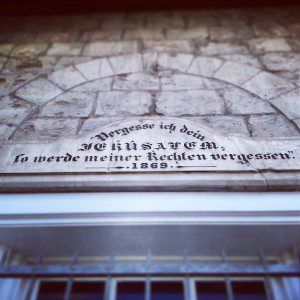
If I forget thee, o Jerusalem…

So reads the famous psalm, but you might think that we had forgotten Jerusalem, given that here we were over three months into the course and yet to visit the country’s capital; holy city for three of the world’s largest religions; a place which apparently 3.5 billion people (I imagine the figure has been extrapolated from a statistically appropriate sample) would like to visit at least once in their lifetime.

Finally, however, the day was here, and it was with a certain amount of excitement that we ascended route 1 into the Judean mountains and entered the city limits. This is a city with so much historical and religious significance that I think around 13 of our 80 field trips will be spent here. It is certainly a place which we will have to become very familiar with in our future lives as tour guides. And here it all begins.

View north over Jerusalem from the Haas Promenade

This excitement was supplemented by a certain amount of nostalgia as we began the day looking over the city from the Haas Promenade viewpoint in East Talpiot. Many years ago, I spent four months living next to this promenade in a place called Kiriat Moriah (I was excited to note that our guide even pointed it out!) while a participant on the Jewish Agency’s leadership training programme for youth leaders from the Diaspora. I have many fond memories of philosophical conversations shared on this promenade while gazing over the tranquil landscape of Jerusalem. Indeed, from this vantage point, the city is extremely calm, belying the many religious, political and economic tensions that are ever-present here.

With our guide’s assistance we surveyed the view before us and identified key points of interest; some we would visit today, many we would visit in the future.

View from the top of the City of David over South and East Jerusalem

From the promenade we journeyed to the limits of the Old City and circled the walls before descending into the City of David. This site (Ir David, in Hebrew) showcases the archaeological remains of the city of Jerusalem at the time of the First Temple, which mostly was outside what are now the Old City walls. The ruins are on a slope running down from the Temple Mount which was the ritual and probably also governmental centre.

Our guide had assured us that this would be the most complex field trip of the course and he fulfilled his promise by taking us through the historiography of the many archaeological digs on the site; with each new dig more was uncovered, shattering previous theories and establishing new ones.

After a short break with a rather cheesy but cute and certainly informative 3D film about the site we continued down past various sites of significance (and their historiography). We noted signs of the Babylonian destruction and heard the story of the discovery of around 50 bullae in one of the digs. These bullae are clay seals for documents; two of them contained names of senior officials mentioned in the book of Jeremiah. It was one of the most significant finds in the whole of the country; corroborating some of the biblical narrative.

Inside the water tunnels in the City of David

We continued into a tunnel in the rock leading to an ancient reservoir watched over by a large guard tower. The current thinking is that these structures are from the pre-Judean rule over Jerusalem and were used to channel water from a nearby spring closer to the city where it could be protected and used for its inhabitants. We wandered through a further tunnel which was probably used to take the water to irrigate crops before heading out of the site. As this field trip was focused only on the First Temple period, we left some of the site for a return visit.

"The Broad Wall": remains of Hezekiah's 7 meter wide northern defensive wall in Jerusalem
“The Broad Wall”: remains of Hezekiah’s 7 meter wide northern defensive wall in Jerusalem

After a lunch stop in the Jewish Quarter of the Old City we continued our exploration of the First Temple period, stopping to see part of the large 7 metre wide ‘broad wall‘ that was built (according to the bible, by the King Hezekiah) to fortify the city against eastern imperial advances. It was at this time that the city walls expanded to include areas which are now the Jewish and Armenian quarters; prior to this archaeologists believe this area was inhabited by refugees from the northern Kingdom of Israel which had been laid waste by the Babylonians and indeed one can see remains of buildings which lie outside the wall.

Remains of the gate tower from Hezekiah's wall around Jerusalem
Remains of the gate tower from Hezekiah’s wall around Jerusalem

We continued, entering a building which contains in its basement the unearthed remains of a gate tower from this northern wall; this was the cities most vulnerable point and indeed it seems that it may have been where the Babylonian’s made their eventual breach as Babylonian arrow heads were found in the excavations.

Model of Jerusalem in First Temple times at the Ariel Center

From this Israelite gate tower we popped across the street to the Ariel Centre which has a few small exhibits related to the First Temple period together with an engaging film giving an overall summary and a model envisaging what the city looked like in this early time. The visit to the centre takes about an hour, is guided by its in house team and I think provides a very good overview of the period, for those interested.

With the First Temple era now witnessed in the flesh (or rather, the stone), and delightfully summarised, we returned home, with many more visits to Jerusalem to look forward to in the future.

The Biblical Judean Lowlands (Shfela)

After exploring the biblical Negev region on our previous field trip, this week we were staying in the biblical period but moving our focus to the area of the Judean Lowlands (the Shfela, in Hebrew). This is an area of hills and valleys that runs roughly from Mt Hebron westwards until meeting the flat coastal plain. Its main city is Beit Shemesh. In biblical times it was a border area between the tribe of Judah and the Philistines, hence it witnessed quite a lot of tension.

We began our day with a drive through the Tzora forest along the so called ‘Sculpture Trail’. This was a project run by the JNF and encouraged mostly local residents (many new immigrants) to make sculptures in the forest. I don’t think I would particularly go out of my way to see these sculptures in the future, but we did also go up the Tel Tzora (you may recall by now that a Tel is an archaeological mound), where we had a commanding view of the area from which to take our bearings, and where we were able to visit the site traditionally associated with the grave of Samson and his father Manoah.

Samson's Tomb on Tel Tzora
Samson’s Tomb on Tel Tzora

Our guide took this opportunity to regale us with the story of Samson from the bible, which took place in the area of the Judean lowlands, pointing out key sites from the viewpoint. And then some members of the group took the opportunity to visit the tomb which is considered a place to pray for strength.

Sculpture Garden in Beit Shemesh

Continuing our artistic opening to the day, we made a brief stop in the Gan Golan sculpture garden in the historical centre of Beit Shemesh. Golan Peli sadly was killed during the first intifada; his parents were artists and used this space next to their house to create sculptures and place them there in his memory. The sculptures all represent traditional ancient life or stories from the bible. It is a small garden, but if one is in Beit Shemesh anyway, it is a nice place to visit.

Inside the ancient cistern at Tel Beit Shemesh

We pulled out of the modern town of Beit Shemesh and returned to biblical times, visiting Tel Beit Shemesh, the site considered to be the location of the biblical city of the same name. Here we read from the book of Samuel, hearing the story of the Philistine capture of the Ark of the Covenant and its return to the Israelites at Beit Shemesh. Our guide pointed out the route it would have taken as it was brought up to the city on a wagon from the Philistine territory. As part of the excavations they have discovered an ancient cistern and we brought out our torches to have a quick wander inside, which brought a small sense of adventure to our enterprise.

The Israelite fortress from the period of King David at Khirbet Qeiyafa

A short journey down route 38 took us to Khirbet Qeiyafa, another archaeological mound. As recently as 2007 excavators here discovered a fortress in the Israelite style. The site has become important as carbon dating of olive pits unearthed here date the site to the period associated with the rule of King David (although as with most archaeology in Israel, this is majority but not consensus opinion). Various other evidence corroborates that it was a Jewish settlement. This would therefore be an extremely important site; the only site we have from this time period. But it remains fairly unknown to the public; excavations are still taking place and it is not signposted at all from the road. To visit, I recommend finding an appropriate tour guide!

View over the Judean Lowlands (Shfela) from Tel Azeka

Close by we visited another archaeological mound: Tel Azeka, which is in the midst of the Britannia Park, a JNF forest funded by donations from the UK (hurrah for the UK!). We ascended the tel and enjoyed a commanding view of the region. Our guide read to us from the story of David and Goliath and pointed out where various elements of the story took place. There is something very powerful in hearing these stories one grew up with in one’s childhood in situ. One begins to envision the tale taking place before one’s eyes; it becomes much more real.

View over the Judean Lowlands (Shfela) from Tel Lachish

Our final visit was our most southern, Tel Lachish. This site is mentioned a huge amount in biblical and non biblical sources from the time, and was host to a large complex of temples in the Canaanite period and the second most important Judean city in the Israelite period. The Assyrian king Sennacherib laid waste to it on his war campaign in 701 BCE and a relief of his battle is exhibited in the British museum in London. We made do with a copy and our guide explained the details of the battle; we were able to see the ramp that Sennacherib’s troops built in order to go up to and rout the Tel. It was a major victory but Sennacherib did not make it to Jerusalem; the bible says that his troops were struck by a plague; his memoirs say that he returned to defend a Babylonian invasion.

The Israelites did return to Lachish eventually but the city was attacked and destroyed again during Nebuchadnezzar’s invasion in the 6th century BCE. A somewhat unfortunate bunch, it seems. The ruins are extensive and the site also commands an outstanding view of the Judean Lowlands over to the coastal plain. It was with this view in our minds that we returned home to Tel Aviv.