Continuing training isn’t a nice-to-have for a licensed Israeli guide; you have to do it to keep your licence. We’re expected to keep our knowledge up to date with ongoing study days, run by specialists, on everything from geology to archaeology to (in this case) Roman religion.
Some of these days are in a classroom; many are out in the field, walking the actual sites. They tend to be pretty demanding, but always interesting.
I mention all this because it’s easy to assume a guide learns the script once and then repeats it for twenty years. The opposite is true. The person walking you round a 2,000-year-old site is meant to know the current thinking, not the version printed in a guidebook a decade ago. That’s the whole point of the system, and it’s a real part of what you’re paying for with a licensed guide.
This summer I spent one of those days going in depth into Roman religion and Roman temples. One of the interesting takeaways was that the largest temple complex in the whole Roman world wasn’t in Rome. It was here in Jerusalem, built by King Herod.
Quick facts & guide tips
| What it is | The Herodian Temple Mount platform, a Roman-style walled sacred precinct (a temenos) |
|---|---|
| The claim | It is considered the largest temple complex in the Roman world |
| Who built it | Herod the Great, from the late first century BCE |
| Also worth seeing | Caesarea and Sebastia, where Herod built temples to Roman gods |
| Guide tip | The Western Wall is a retaining wall. Picture the platform it holds up, not just the wall itself. |
The largest sacred enclosure Rome ever saw
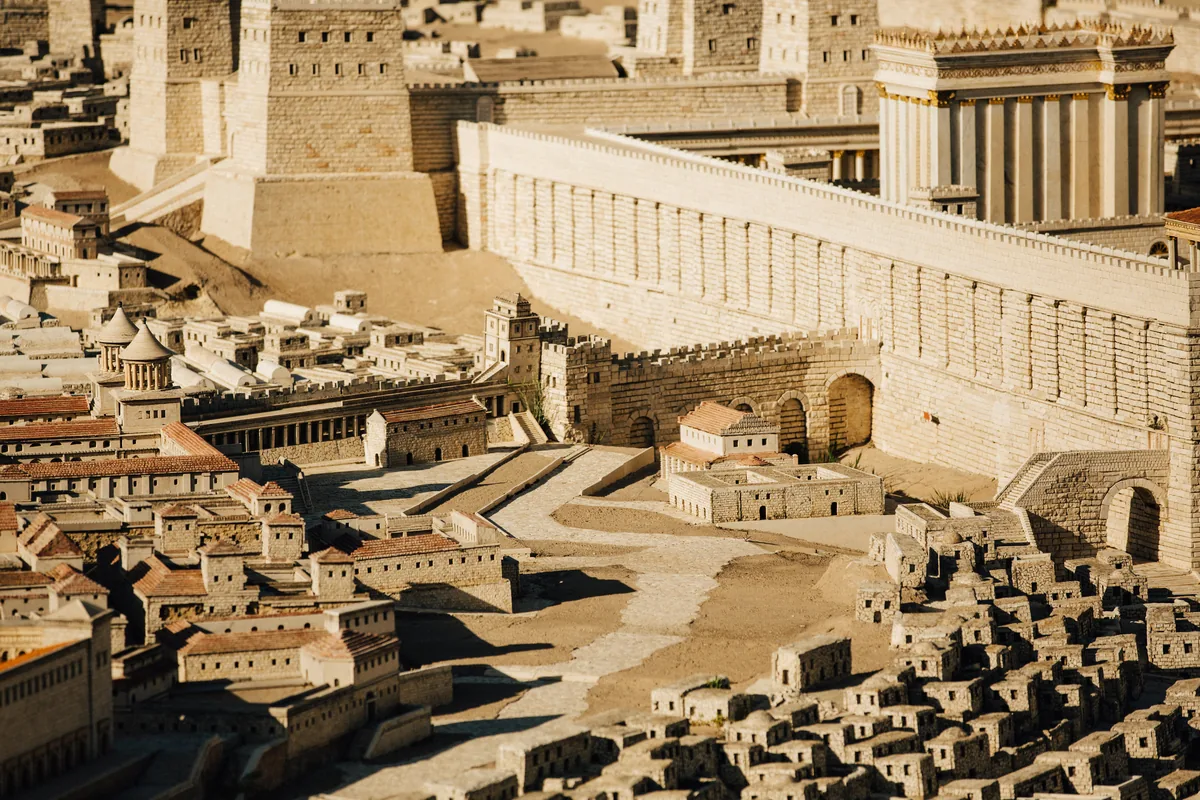
When Herod the Great rebuilt the Temple in Jerusalem towards the end of the first century BCE, he didn’t only rebuild the sanctuary; he built the vast raised platform it stood on, and that platform is considered the largest sacred enclosure anywhere in the Roman world at the time. Today it’s referred to as the Temple Mount or the Haram al-Sharif.
The numbers are still hard to take in. The platform covers around 144,000 square metres (36 acres), and Herod created much of it artificially, raising the ground on a honeycomb of arches and holding the whole thing in place with colossal retaining walls. One of those retaining walls is the Western Wall, which means the most important place of Jewish prayer today is, in engineering terms, the outer side of Herod’s enormous building project.
The Roman pattern Herod was working from
A Roman temple complex followed a recognisable formula. Three elements sit together. The temple itself stands on a high podium, approached by a single grand staircase at the front (a Roman temple has a front; a Greek one, with steps on all four sides, doesn’t). Around it runs the sacred courtyard, the temenos. And attached to the precinct is a basilica, a long colonnaded hall used for trade, law and public business.
Put those together (a temple, a sacred square and a grand civic hall, planned as one space) and you have the standard Roman religious and civic centre. You can see it on the ground at Caesarea, and in spectacular form around the region at places like Jerash in Jordan and Baalbek in Lebanon.
Herod knew this formula intimately. He was one of the great builders of his age, and a client king who had spent time in Rome. When he laid out the Temple Mount, he used the Roman vocabulary: the raised platform, the enclosing colonnades and, along the southern edge, a huge basilica (the Royal Stoa).
Roman in form, Jewish in purpose
What makes the Temple Mount remarkable is that Herod took this thoroughly Roman template and used it for something entirely un-Roman. The architecture was imperial; the religion practised in it was Jewish, with a single God and no image in the sanctuary at all (the very opposite of a Roman temple, which existed to house a statue of the god).
So it isn’t really a case of Roman “influence”, the way we’d talk about a fashion catching on. It’s closer to deliberate borrowing: Herod took the most impressive architectural language available in his world and bent it to serve the Jewish Temple. I can’t think of anywhere else it was done quite like that.
There was politics in it too. Herod ruled at Rome’s pleasure, and building in the imperial style was a way of showing his loyalty in stone. At the same time, a grand new Temple for the Jews was a way of trying to ingratiate himself with the local population.
Herod’s fully Roman temples
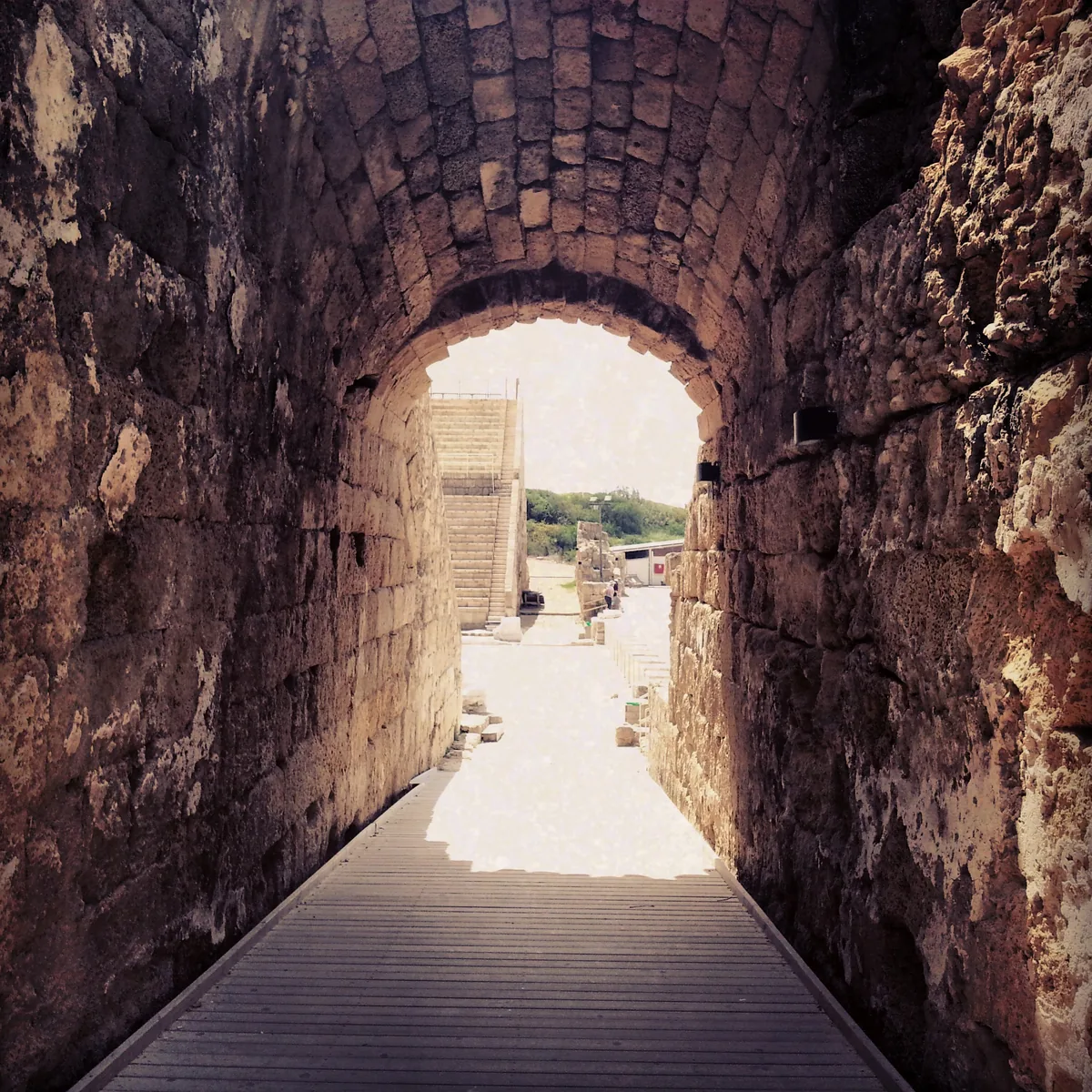
If you want actual Roman temples in Israel (dedicated to Roman gods, the genuine article) Herod built those as well, and the remains are still there to visit. The clearest is at Caesarea, the harbour city he raised on the Mediterranean coast. On a high platform overlooking the port he built a temple to the goddess Roma and to the emperor Augustus, positioned so it was the first thing a ship’s passengers saw as they came into harbour.
When I guide at Caesarea I like to compare it to the Statue of Liberty. It’s a statement about who you are. For many visitors to the US, the Statue of Liberty would have been the first thing they saw as they approached by sea; a celebration of liberty, an important American value. Likewise, those coming into the main port of Herod’s Judea would have had no doubt about the dominant culture when they saw the Roman temple.
Herod also consecrated a temple inland at Sebastia (ancient Samaria), a city he rebuilt and renamed in Augustus’s honour; Sebastos is simply the Greek for Augustus. The staircase and column bases of its temple still stand on the hilltop. Sebastia is in the West Bank, though, and getting there is complicated enough that I don’t put it on my tours, even if I’d happily go myself.
This was the standard move for a client king in the Roman East: a temple to Rome and the emperor was a public statement of where your loyalty lay.
How Rome treated the fall of Jerusalem
The scale of what Herod built helps explain what came later. When Rome crushed the Jewish revolt and destroyed Jerusalem in 70 CE, the Temple’s treasures were carried back to Rome in triumph; the Arch of Titus, which still stands in the Roman Forum, shows the great menorah being paraded through the streets.
The emperor Vespasian then built the Temple of Peace in Rome partly to house those spoils. You don’t make a centrepiece out of the loot from a minor provincial shrine; you do it when you’ve beaten something that genuinely impressed you. The way Rome treated the fall of Jerusalem is itself a measure of how much the place had come to matter.
How this plays out when I’m guiding
When we stand at the southern steps of the Temple Mount, or look out over the platform, I can do more than reel off dates. I can show you why the stones are laid out the way they are, point to the Roman pattern in the design, and explain how an architectural language invented to glorify pagan gods ended up framing the holiest Jewish site of its day.
That’s what’s great about these training days. The sites don’t change much from year to year, but our understanding of them does, and this way I can always give people the latest information.
If you’re planning a trip to Jerusalem and this is the kind of thing you enjoy (the why behind the what) it’s exactly what I love doing on a day’s touring.


Leave a comment