We have been studying Islam in class of late and so it was time to spend some time in Jerusalem exploring some of the holy sites and the history of Muslim rule over the city.
We began our day in the area commonly known as the Temple Mount, referred to by Muslims as al-Haram ash-Sharif. This plateau is considered to be the place referred to in the Qur’an as al-Aqsa, or the farthest mosque. In this famous passage Mohammed travels from Mecca to this far away place in an episode known as the Night Journey. He then tethers his horse and ascends to heaven.
Quick facts & guide tips
| Where | The Temple Mount / al-Haram ash-Sharif and the surrounding Muslim Quarter of the Old City of Jerusalem. |
|---|---|
| Significance | Third holiest city in Islam after Mecca and Medina; site of the Dome of the Rock and the al-Aqsa Mosque, identified with Mohammed’s Night Journey. |
| Access | Non-Muslims enter the platform via the Mugrabi Gate (beside the Western Wall) during set visiting hours; the mosques themselves are closed to non-Muslims, and non-Muslim prayer on the platform is forbidden. |
| What to bring | Modest dress required; bags are searched, and Christian or Jewish religious items will not be allowed in. |
On the Temple Mount / al-Haram ash-Sharif
Although the Qur’an does not specifically mention Jerusalem in this episode, early commentaries already identify al-Aqsa as being synonymous with the city, and for this reason it is the 3rd holiest city in Islam after Mecca & Medina. The two large mosques on the site are the grey-domed al-Aqsa, marking the site where Mohammed arrived with his horse, and the famously striking Dome of the Rock (Masjid Qubbat As-Sakhrah), with its stunning gold dome, which marks the site where Mohammed ascended to heaven.
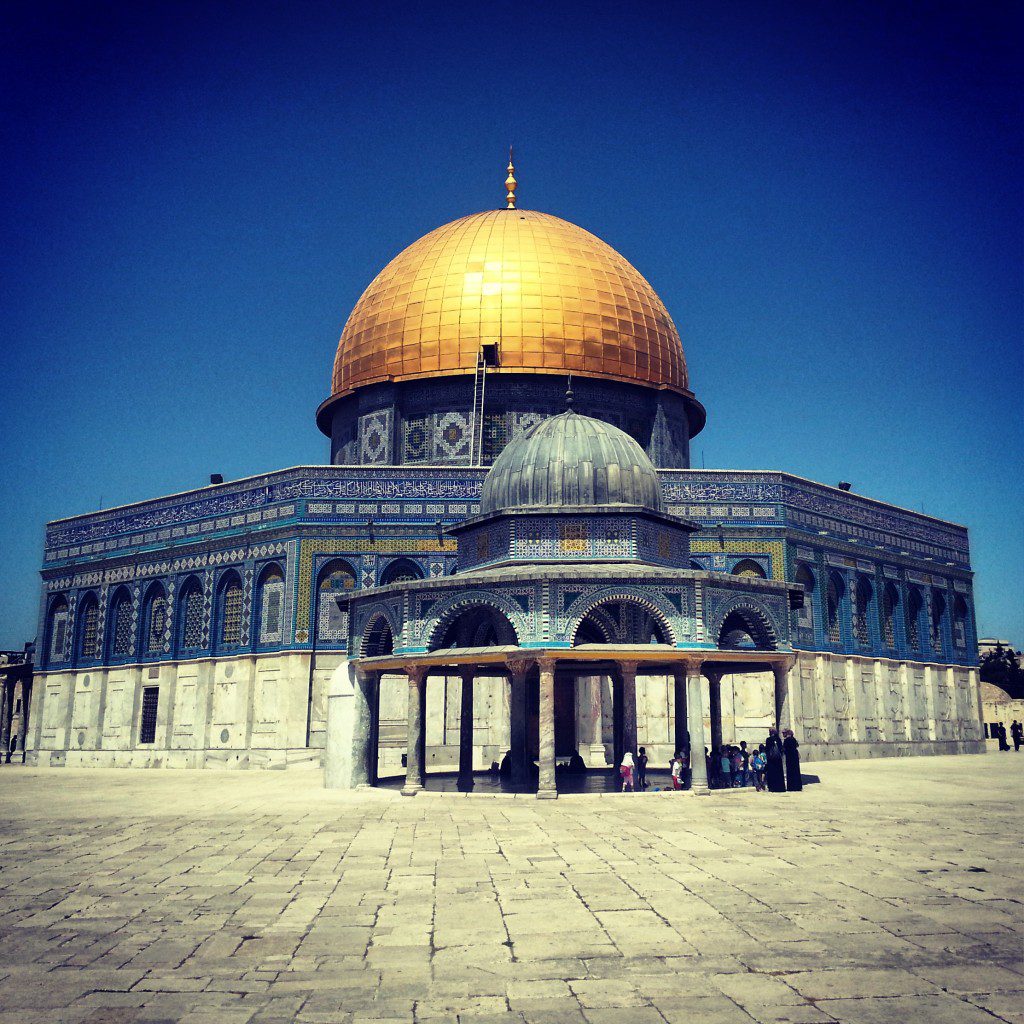
Unfortunately it is no longer possible for non-Muslims to enter the mosques, but I recall visiting the Dome of the Rock as a child on a family trip and remember seeing inside it the rock from which it takes its name. There is an indentation on the rock identified as being Mohammed’s footprint; the rock is also considered to be the site of the story of the binding of Isaac.
Access to the area which I will for convenience’s sake refer to as the Temple Mount is complicated. There is one entrance for non-Muslims – the Mugrabi Gate which is just to the right of the Western Wall. There you are checked thoroughly for weapons or any Christian or Jewish prayer books/bibles – the area is very sensitive and non-Muslim prayer is forbidden. The Israeli authorities who control access to the site are very concerned to avoid any potential provocation, hence the strong controls over who can access the site; where, when and with what.
Once through the security it is possible to enjoy the impressive expanse of the Herodian podium and the two remarkable mosques based upon it. The original mosques were built in the 7th century when the original Church of the Holy Sepulchre was still standing. Our guide illustrated to us that in fact the structure was almost an exact copy of the Church – a rotunda (marking the site of the miracle); a basilica for members of the public to pray and also a garden in between.
Although our focus was on the Muslim sites we took advantage of our visit to also look out for and learn about areas of the Jewish Temple and the Crusader church known as the Templum Domini. We also saw where the Templar knights were housed in this period.
Mamluk architecture in the Muslim Quarter
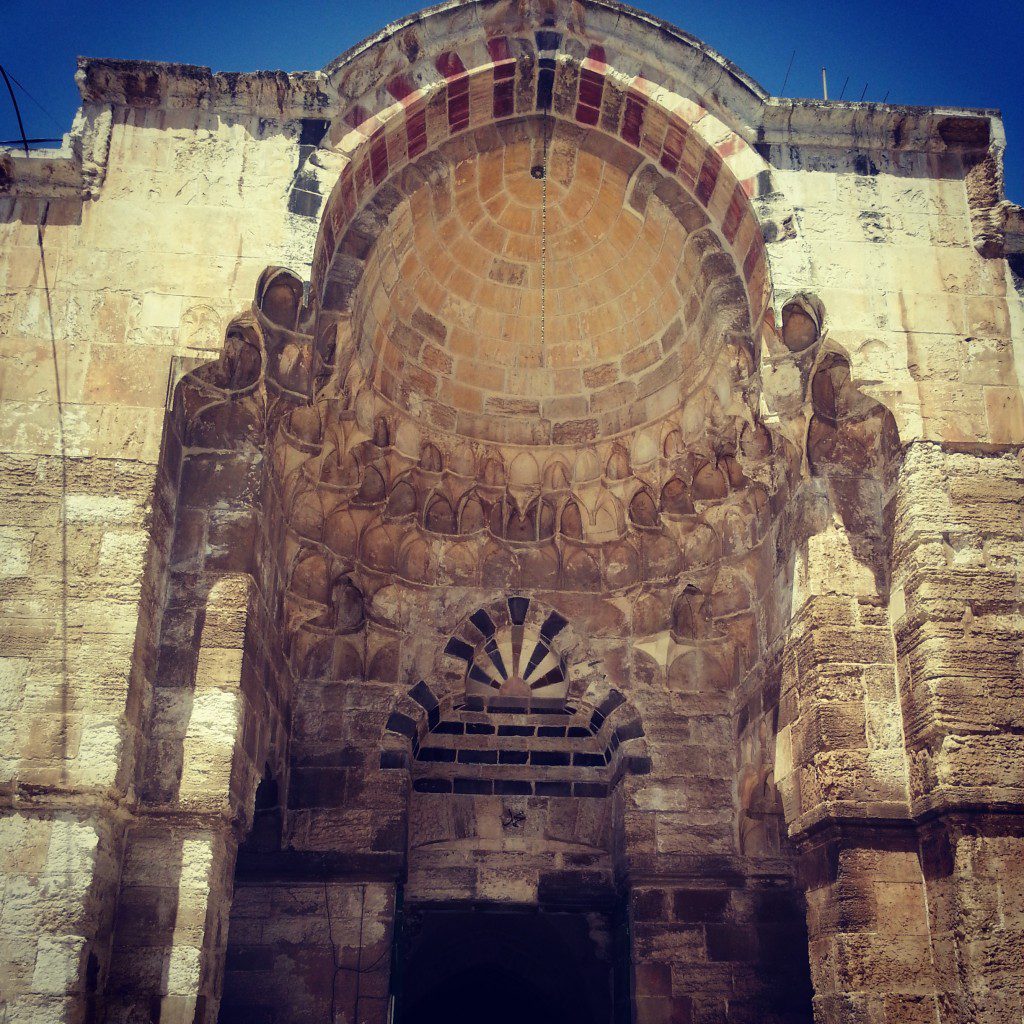
We continued around the site as our guide pointed out examples of 14th century Mamluk architecture and also the mausoleum for leaders of the Palestinian liberation movement.
We exited the plateau and began a tour of the Muslim Quarter. As this was largely constructed by the Mamluks, we focused on further understanding their architecture and also noting the various madrasas (schools) that they constructed. Through the use of maps from different periods our guide explained to us how the streets of Jerusalem changed over the centuries and by whom the alterations were made.
Abu Shukri and the Little Western Wall
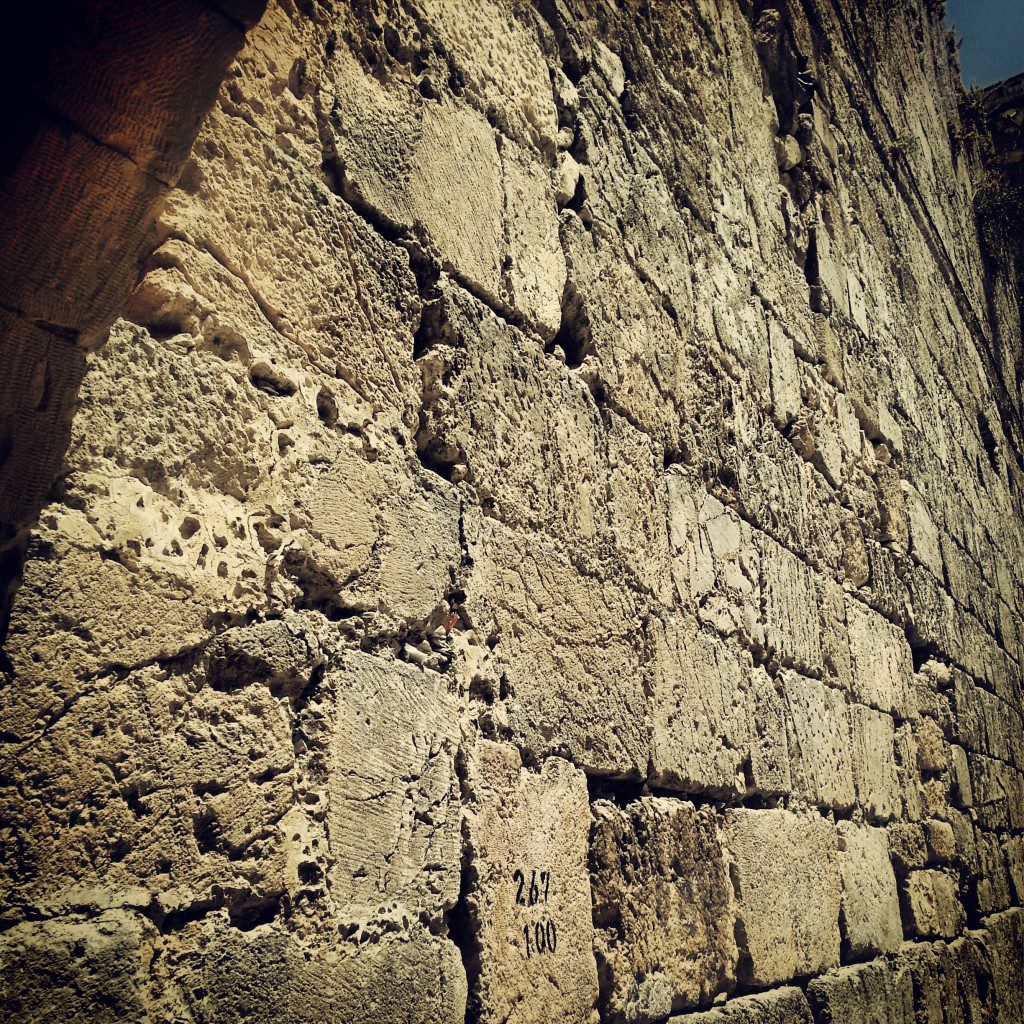
After enjoying a good bowl of hummus in the famous Abu Shukri restaurant we made a short stop at a Jewish site, although one located in the Muslim quarter. Known as the Little Western Wall, this is a continuation of the Western Wall, north of what is currently exposed in the plaza. The plaza is a relatively new phenomenon, and what is nice about this section is that it is at the height and width of the wall until the Israelis created the plaza in 1967 when they captured the old city of Jerusalem. It is possible to relive the experience of being at the wall in the centuries before the state, and interestingly it is not separated between men and women unlike in the main plaza. I had no idea it existed so it was a very interesting discovery; some Jews even say it is holier than the Western Wall which most people visit as it is closer to where the Holy of Holies would have been situated.
We continued wandering the streets of the Muslim Quarter, witnessing more examples of Mamluk architecture such as the alternating light and dark style of the ablaq masonry, before the day drew to a close.


Leave a comment