Some stories turn up again and again across the ancient world. One of them is simple: a god dies, and a goddess brings him back. It appears in Egypt, in Anatolia, in Greece and across the Near East, always in more or less the same shape.
It came up on the guide-training day on Roman religion I did this summer (I’ve written about that day from other angles). Here I follow that one story to three places you can visit in Israel.
Quick facts & guide tips
| What this is | An ancient repeating myth (a god dies and returns) and the secret cults that carried it around the Roman world |
|---|---|
| The cults | Mystery religions you had to be initiated into; Mithras, Isis and Cybele among them, closed and secret by design |
| See it in Israel | The underground mithraeum at Caesarea, Pan’s spring and cave at Banias, the city Dionysus was said to found at Bet She’an |
| Period | Roman-era, roughly the first century BCE to the fourth century CE |
| Guide tip | At Banias, look for the niches cut into the cliff beside the cave; they held statues and offerings |
The god who dies every winter
Across the ancient world the same figure keeps reappearing: a young man, loved by a goddess, who dies, is mourned and then comes back. In Egypt he is Osiris, who dies and is brought back by his wife Isis. In Anatolia he is Attis. Across the Near East he is Tammuz. The names and the details change; the shape stays roughly the same.
The people who told these stories were farmers, and the myth follows the farming year. The god’s death is the winter, when nothing grows and the goddess grieves; his return is the spring, when the fields come back to life. That is why the story mattered so much, and why it spread so far, including to Israel.
How the mystery cults worked
A mystery cult was a religion that you couldn’t just join. You had to be accepted. This is a big difference from the open civic worship of Greece and Rome, where anyone could stand in front of a temple and watch a sacrifice.
These cults were closed. There were initiations. The central rituals were kept secret (mysteria is simply the Greek for “the secret things”) and you climbed through grades of membership, each one opening a little more of the inner teaching. Because of this secrecy, we still know very little about the details of the practice.
Several of these cults travelled west from the East and became hugely popular. The cult of the Great Mother, Cybele, was brought to Rome in 204 BCE as a great stone, because an oracle had promised she would protect the city against Hannibal. Her consort Attis was one of those dying-and-rising figures, and her priests, the galli, followed him into ritual self-castration (which sounds like quite the commitment). The Egyptian cult of Isis came too, with its shaven-headed priests and its story of Osiris raised from death.
Mithras and the mithraeum at Caesarea
The most popular of these cults among Roman soldiers was Mithras. The main image of Mithras, found in his sanctuaries right across the empire, shows the same scene, called the tauroctony: the god kneeling on the back of a great bull, hauling its head back by the nostrils and driving a dagger into its neck, while a dog, a snake, a scorpion and a raven crowd around it.
It looks like violence, but it’s actually meant as creation. The story, which came originally from Persia, is that the bull’s death is what brings life: at the moment it’s killed, every plant on earth springs up out of its body and its blood. It’s the same cycle again, death feeding growth.
The sanctuary itself is the part that interests a visitor. A mithraeum was usually underground, a long narrow room with benches down each side and often a single opening in the roof, positioned so that the sun struck the altar at one precise moment. There were seven grades of membership, and where you sat depended on your grade.
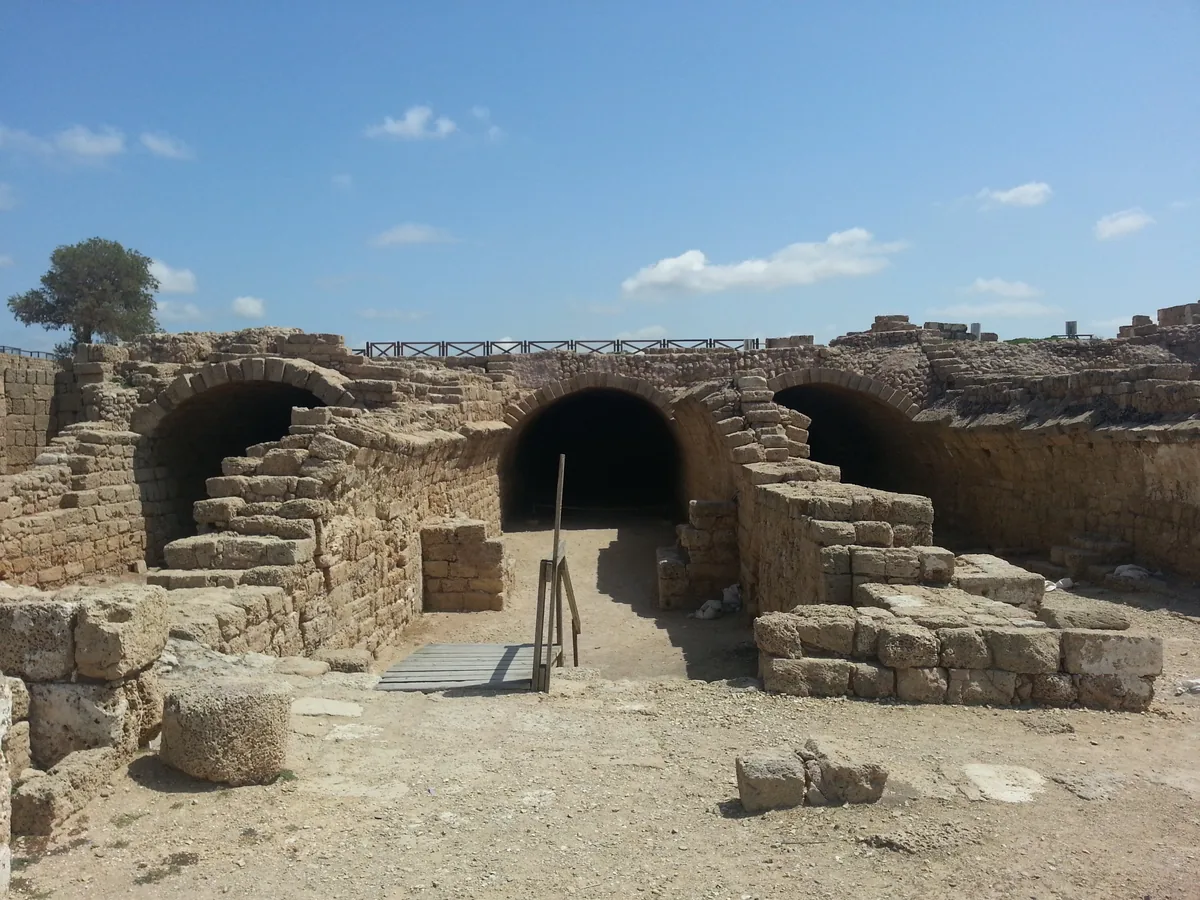
In Israel, there’s a mithraeum at Caesarea, confirmed by the discovery of a medallion showing Mithras killing the bull inside it. It’s tucked inside one of the vaulted storerooms (the horrea) that run along the old harbour at the foot of the hippodrome. It’s not normally accessible but the lecturer said that sometimes if you asked the park staff they’d let you inside.
Pan at Banias
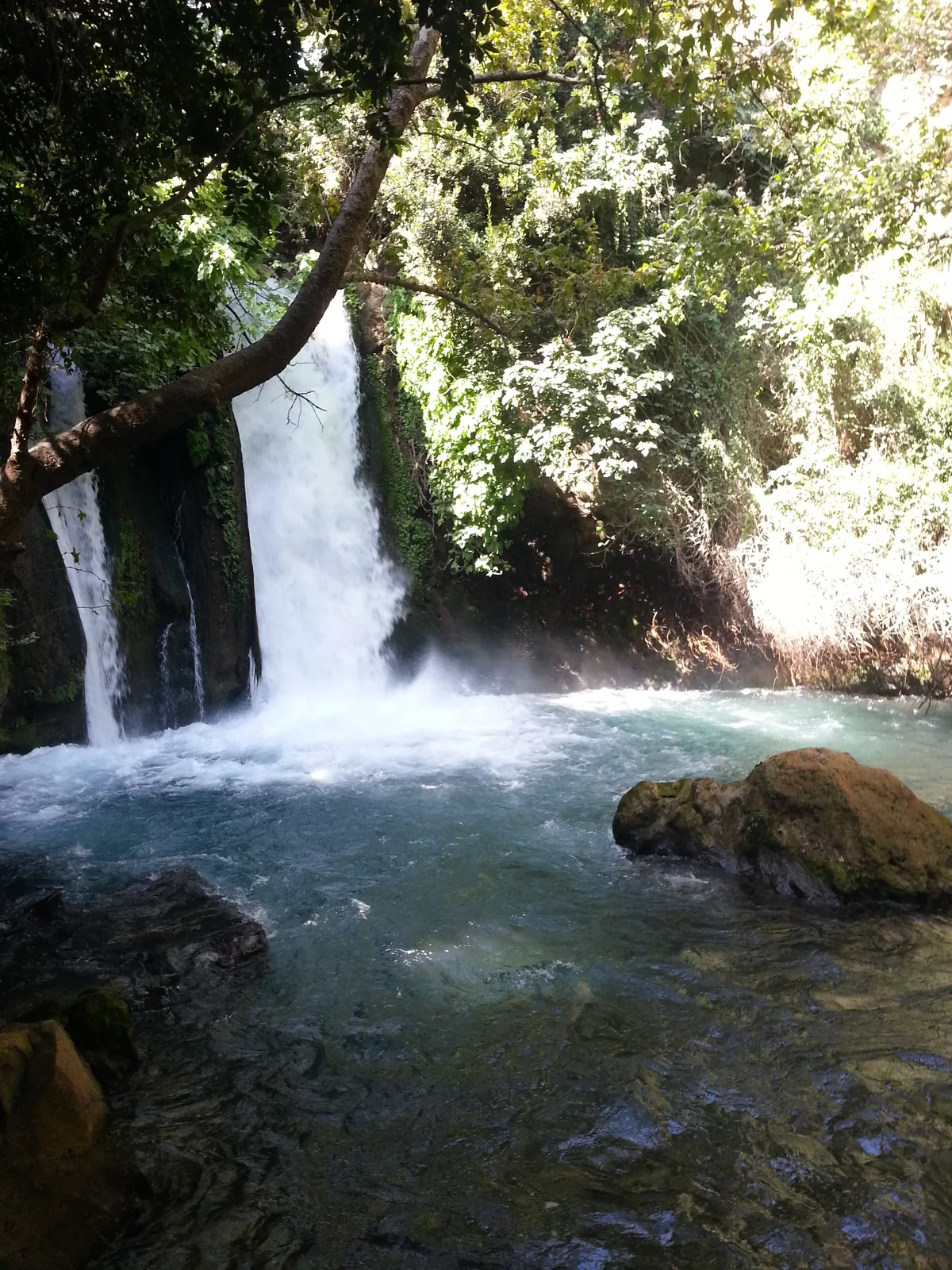
During the lecture, I was reminded of my visit to Banias on the tour guide course. Located in the north, at the foot of Mount Hermon, Banias was an ancient sanctuary of Pan, the goat-legged god of the wild, of the flocks and of the untamed places. The heart of it is a great spring that once poured straight out of a cave in the cliff face, with niches cut into the rock for statues and offerings.
Pan is not one of the dying-and-rising gods. He belongs to an older, wilder layer of this religion, the one that worshipped at springs and caves and in the woods rather than inside tidy temples. But that’s exactly why Banias sits well here. The whole world these mystery cults grew out of took it for granted that the divine lived in wild places (a cave at the foot of a mountain, a spring bursting out of rock) and there are few better places to feel that for yourself than Banias.
Dionysus at Bet She’an
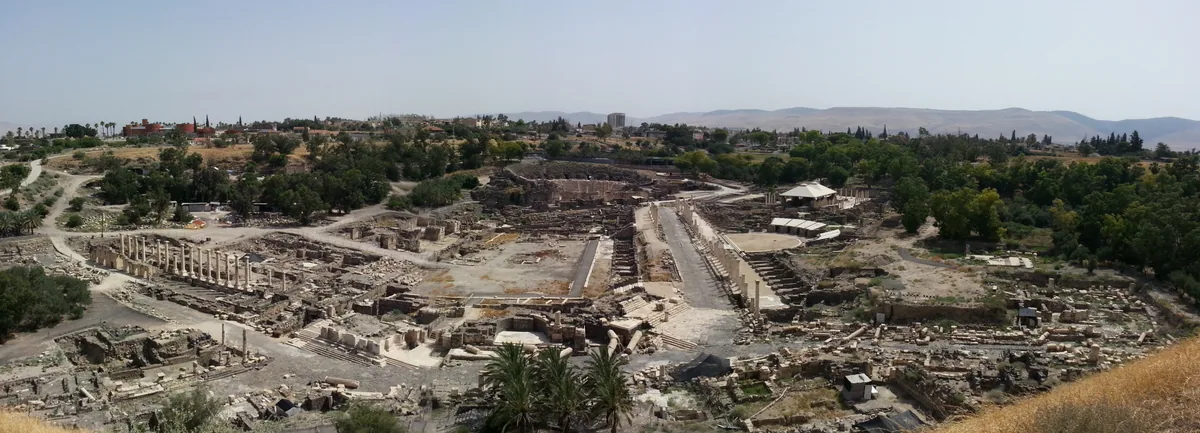
Bet She’an, the Roman city of Scythopolis, was said to have been founded by the god Dionysus. The story goes that his nurse, Nysa, is buried there, which is why the city also carried the name Nysa-Scythopolis.
Dionysus earns his place in this company because he too carries the death-and-rebirth idea. His emblem is the thyrsus, a staff topped with a pine cone, and the lecturer explained why the pine cone matters: it opens up after a fire and releases its seeds, so new growth follows the burning. The same cycle that runs through Osiris and Attis runs through the wine god as well.
When I’m guiding
Without the story, all three of these places can look like bare ruins: a cluster of vaulted rooms by the sea, a spring and some empty niches in a cliff, a ruined city in the Jordan valley.
At Caesarea I can show you where the followers of Mithras met. At Banias I can show you why people came to worship at a cave and a spring. At Bet She’an I can tell you whose city you’re walking through, and why.
We can imagine the rituals and the motivations and hopes of those taking part. And consider how their faith helped carry them through their lives.
If you’re planning a trip through Caesarea, the Galilee or the north, we can definitely make this conversation part of it.


Leave a comment