Contents(10)
Jerusalem sits more or less in the middle of the country, so you can achieve a lot within a day’s travel. The Dead Sea, Masada, Tel Aviv, Bethlehem, the Galilee and more are all doable day trips (although the Galilee is a long day on the road).
The trips below are the ones I run most, with drive times and where a guide actually helps.
Most of my guests base themselves in Jerusalem for a few nights and then ask the same question: what can we actually see in a day from here? Because Jerusalem sits more or less in the middle of the country, it’s a great base.
Within an hour or two in almost any direction you can be floating in the Dead Sea, climbing Masada before the heat arrives, or walking into Bethlehem. Below are the day trips I run most often from Jerusalem, with how long each one really takes, what I think is worth your time, and where a guide and a car change the day (I’ll also tell you where they don’t).
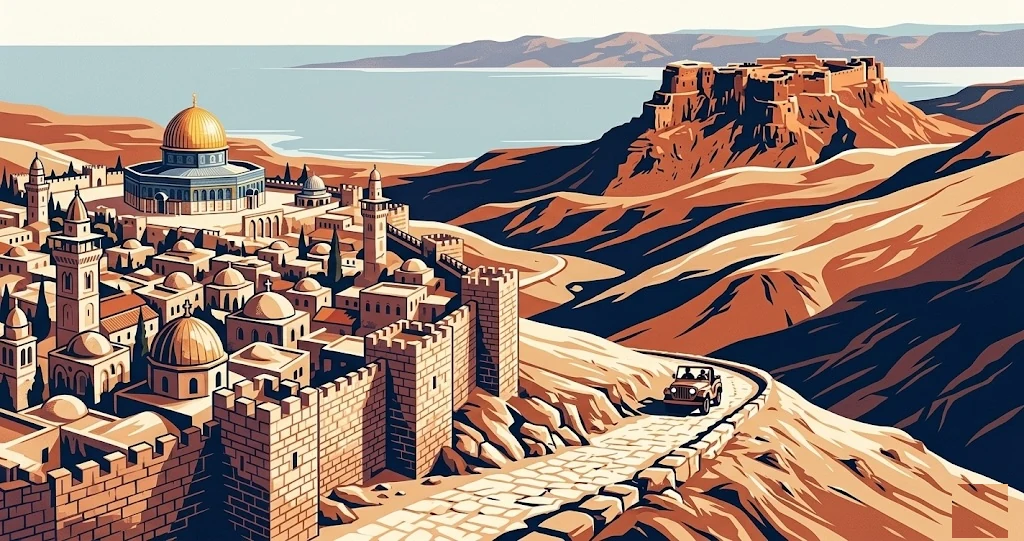
The Dead Sea, Masada and Ein Gedi
This is the classic Jerusalem day trip. It’s about an hour to the northern Dead Sea beaches and roughly an hour and a half down to Masada (you descend to the lowest point on dry land anywhere on earth, around 430 metres below sea level, which is part of the drama).
I usually run the three together: starting with Masada to get the biggest drive out of the way (and avoid the afternoon heat), the Ein Gedi nature reserve for a walk to a waterfall, then the Dead Sea itself in the afternoon to float and rinse off.
You can do it by public bus but it’s not super frequent, so hiring a car is better.
This is a day that many people will do by themselves. A guide can add value by guiding you quickly around the Masada highlights (wandering directionlessly in the summer heat isn’t fun) and giving the historical context to both Masada and Ein Gedi.
They can also advise on where to go to the Dead Sea depending on what level of facilities you want and whether you want the authentic mud experience, because not all beaches are equal. I cover this area in my Judean Desert itinerary.
Bethlehem
Bethlehem is super close, so close that on Christmas Eve some people even make the journey on foot from the Old City of Jerusalem! By car it’s about twenty minutes, just over the checkpoint into the territory controlled by the Palestinian Authority.
The Church of the Nativity and Manger Square are the obvious draw, and for a lot of my Christian guests this is the single most meaningful half-day of their whole trip.
The crossing is straightforward most of the time, but not always: there’s a checkpoint, the rules change with the political mood, and Israeli rental cars and most Israeli guides can’t go in.
I work with a trusted Palestinian colleague on the other side, which is the best way to do it, so you get a licensed guide for the city itself and a seamless handover. It’s also a good way for you to hear from a Palestinian perspective during your trip.
I pair Bethlehem with Jericho when guests want a fuller day (see my Bethlehem and Jericho itinerary).
Jericho
Jericho is about thirty to forty-five minutes from Jerusalem, dropping down through the desert towards the Jordan Valley.
It’s reckoned to be one of the oldest continuously inhabited towns anywhere, and you can stand at the Tell es-Sultan excavations and look at walls that are thousands of years old, ride the cable car up to the Monastery of the Temptation, and see the traditional site of Jesus’s baptism nearby.
Like Bethlehem it sits in Area A of the West Bank (controlled by the Palestinian Authority), so the same crossing logic applies and I handle it with a local colleague.
It combines naturally with Bethlehem, or with the Dead Sea if you’d rather mix ancient history with a float.
Tel Aviv and Jaffa
Tel Aviv is forty-five minutes to an hour away and feels like a different country: beaches, Bauhaus, a serious food scene, and old Jaffa with its port and flea market at the southern end.
Plenty of guests who’ve had a few intense days in Jerusalem want exactly this contrast, and it’s an easy one. There’s a fast train, regular buses and shared taxis (sheruts). The train is normally faster than going by car.
You can definitely wander the city and enjoy it alone. Where a guide can be useful is to bring the historical context, and help you decide which areas to focus on.
There are unique stories to different parts of the city and my Tel Aviv itinerary and Jaffa itinerary are designed to help you make the most out of your visit.
Nazareth and the Sea of Galilee
This is a longer day, about two to two and a half hours north, but for many it’s the heart of the trip.
Nazareth has the Basilica of the Annunciation; around the Sea of Galilee you have Capernaum, the Mount of Beatitudes and the Yardenit baptism site on the Jordan.
Public transport this far is slow and awkward, so this is one where a car (mine or a rental) really does change what’s possible.
It’s the spine of my Galilee itinerary, and there’s a Jewish-heritage version too in my northern Israel itinerary.
Caesarea, Haifa and Akko
The northern coast is about an hour and a half to Caesarea, then another forty-five minutes or so up to Haifa and a little beyond to Akko.
You can string the three together in a day: a Roman harbour city with a theatre still in use, the Bahá’í Gardens descending Mount Carmel, and the Crusader and Ottoman old city of Akko, which is one of my favourite places to eat.
It’s a lot of ground, and honestly it’s the day where self-driving turns into a navigation and parking job; with a guide you spend the time exploring rather than circling for a space. This is my Caesarea, Haifa and Akko itinerary.
The Judean foothills
This is the day trip almost nobody writes about, and it’s twenty to forty-five minutes west of the city. The hills between Jerusalem and the coast hold the Sorek stalactite cave, numerous ruined biblical cities, the bell caves and dig-for-a-day archaeology at Beit Guvrin, and a cluster of good wineries.
It’s gentle, it’s green in spring, and it’s a lovely change of pace if you’ve already done the big-ticket sites or you’re travelling with children. There’s no real public-transport option out here, so it only works with a car, and it’s the kind of day I tend to build to order around what a particular client enjoys.
Hebron
Hebron is about an hour south, and I’ll be straight with you: it’s the most politically charged day trip on this list.
The Cave of the Patriarchs, traditional burial place of Abraham, Sarah, Isaac and the rest, is one of the oldest continuously revered sites in the world and deeply moving to stand in.
It’s also a divided, sensitive city, and a visit needs an organised, properly briefed approach rather than a casual drop-in.
Here a guide will add a lot of value, both in terms of the historical, religious and political context, and also in making sure that we do the visit in the safest possible way.
How to choose, and how to reach them
For every trip above you really have three options. Public transport is the cheapest, but also the least time efficient, and most of it stops for Shabbat from Friday afternoon to Saturday night.
A rental car gives you freedom, but you need to take care of parking, navigating and sometimes rather confusing road markings.
A private guide with a car (which is what I do) costs more, but it folds the driving, the timing, the history and the local arrangements into one package you don’t have to manage.
When I’m helping people plan their visit I’ll be honest about the days when a guide will add most value and help you make the right decisions for what you’re trying to achieve on your trip, within your budget.
Frequently asked questions
Can I do the Dead Sea and Masada in one day from Jerusalem?
Yes, comfortably, and it’s the trip I run most. Masada early, Ein Gedi for a walk, the Dead Sea in the afternoon. The only real constraint is heat: in summer you want to be up Masada not long after it opens, which is the main reason an early, planned start matters.
Do I need a guide, or can I just rent a car?
You definitely don’t need a guide and can manage most things in a rental car (the only exception is going into Palestinian Authority-controlled areas like Bethlehem and Jericho; some rental companies may have a broader West Bank ban to also include Israel-controlled areas).
A guide brings a lot of value, beyond the guiding itself. It saves you time and stress on navigation or looking for parking, and dealing with the logistics of the car rental.
A separate driver is even more convenient as it gives you a lot of flexibility (you can start in one place and finish in another without having to go back to a parking lot), in the hot summer months they can pre-cool the car before you get there, and there’s always someone to watch over your belongings.
Ultimately it comes down to budget and what you want out of the trip. Some people just love doing the driving!
Is it safe to visit Bethlehem or Jericho?
In normal times, yes, and I take guests regularly. They’re under the control of the Palestinian Authority, so there’s a checkpoint to go through.
The situation can change, which is exactly why I arrange these with a trusted local colleague. I keep an eye on conditions and I’ll tell you honestly if a given day isn’t a good idea.
How far in advance should I book a day trip?
For a private day, the more notice the better, particularly in the spring and autumn high seasons and around the Jewish and Christian holidays, when good guides and the better small sites get booked up. A few weeks is comfortable; a few months is safer for peak dates.
What runs on Shabbat?
Public transport largely shuts from Friday afternoon to Saturday evening, and many businesses close, though the situation is more relaxed in Arab towns, in Tel Aviv and at the major sites.
However, most of the major tourism sites are open on Shabbat, so a private trip can run pretty much as normal, which is one of the practical reasons people book one for a Saturday.
Can you build a day trip around what we’re interested in?
Of course. Tell me who’s coming, what you care about and how much driving you’re happy with, and I’ll build the day around it rather than fitting you to a fixed route.
Tell me what you’ve got in mind and we’ll take it from there.